




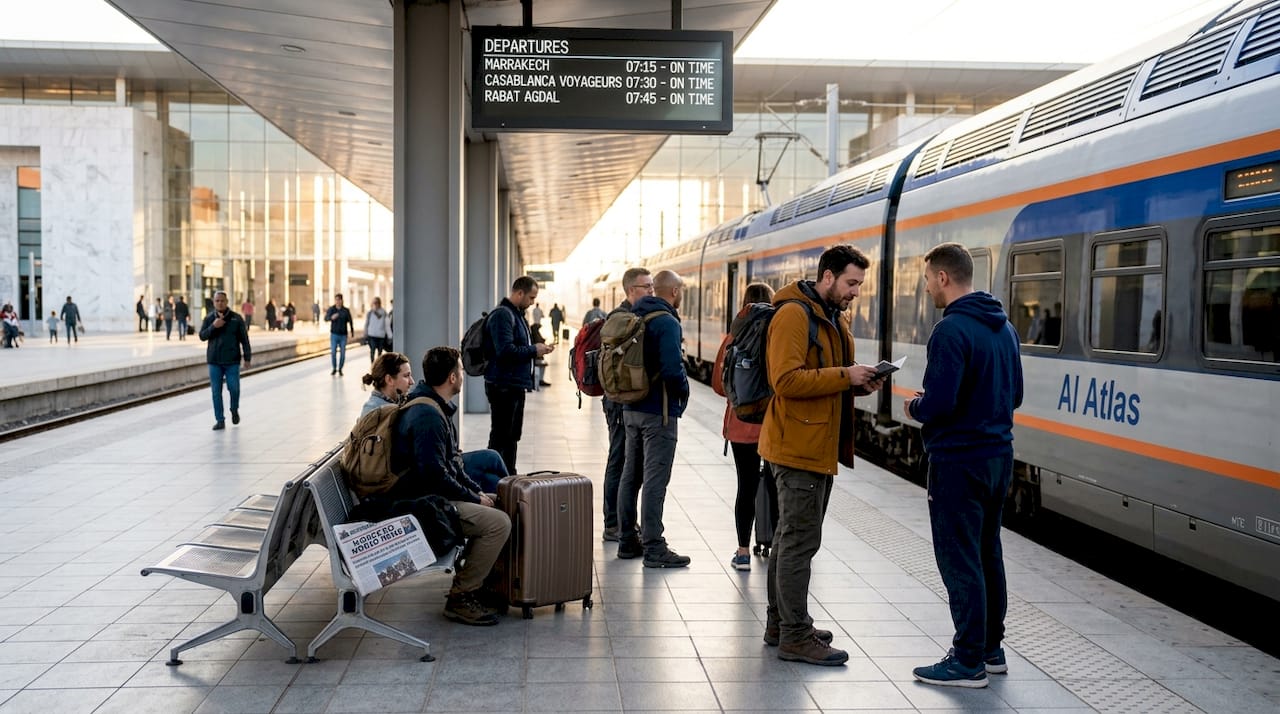
- The Marrakech Express is an informal phrase referring to Morocco’s rail journey from Casablanca to Marrakech, not an official train service.
- It offers a reliable, affordable, and culturally immersive travel experience through scenic landscapes in under three hours.
- Traveling in second class enhances the authentic Moroccan experience, connecting travelers with local life beyond luxury expectations.
There is a good chance you searched “Marrakech Express” expecting to find a dedicated luxury train gliding through Morocco’s countryside. That is a reasonable assumption, but the reality is actually more interesting. The term has no official train service behind it. It is a phrase rooted in a real 1966 train journey that inspired Crosby, Stills & Nash to write one of rock’s most iconic travel songs three years later. Today, the Casablanca to Marrakech rail route is run by ONCF, Morocco’s national rail operator, and it delivers something that no luxury branding could manufacture: genuine, affordable, culturally rich travel through a country unlike anywhere else on earth.
Table of Contents
- Key Takeaways
- The Marrakech Express route explained
- Ticket classes, pricing, and booking tips
- What you actually see and experience on board
- Arriving in Marrakech and planning what comes next
- My honest take on the Marrakech Express experience
- Plan your Morocco rail trip with expert support
- FAQ
Key Takeaways
| Point | Details |
|---|---|
| “Marrakech Express” is not a branded train | The term is a marketing phrase and song reference, not an official ONCF service name. |
| The route takes under 3 hours | The Al Atlas direct train covers Casablanca to Marrakech in approximately 2 hours and 40 minutes. |
| Tickets are affordable | Second-class fares run 90 to 150 MAD; first class costs 150 to 240 MAD depending on timing. |
| Book online before you travel | Online booking secures your seat and avoids credit card issues that can occur at station ticket machines. |
| Train travel pairs well with guided tours | Marrakech serves as a rail gateway for city tours, Atlas Mountain excursions, and desert adventures. |
The Marrakech Express route explained
Morocco’s national rail operator, ONCF, runs one of Africa’s most reliable and modern rail networks. It connects the country’s major cities, including Casablanca, Rabat, Fes, Tangier, and Marrakech. For most international visitors, the most useful single route is the direct connection between Casablanca and Marrakech.
The Al Atlas train takes about 2 hours and 40 minutes and runs roughly every hour throughout the day, from early morning until late evening. That frequency makes it genuinely flexible for travelers who do not want to plan around a single daily departure.
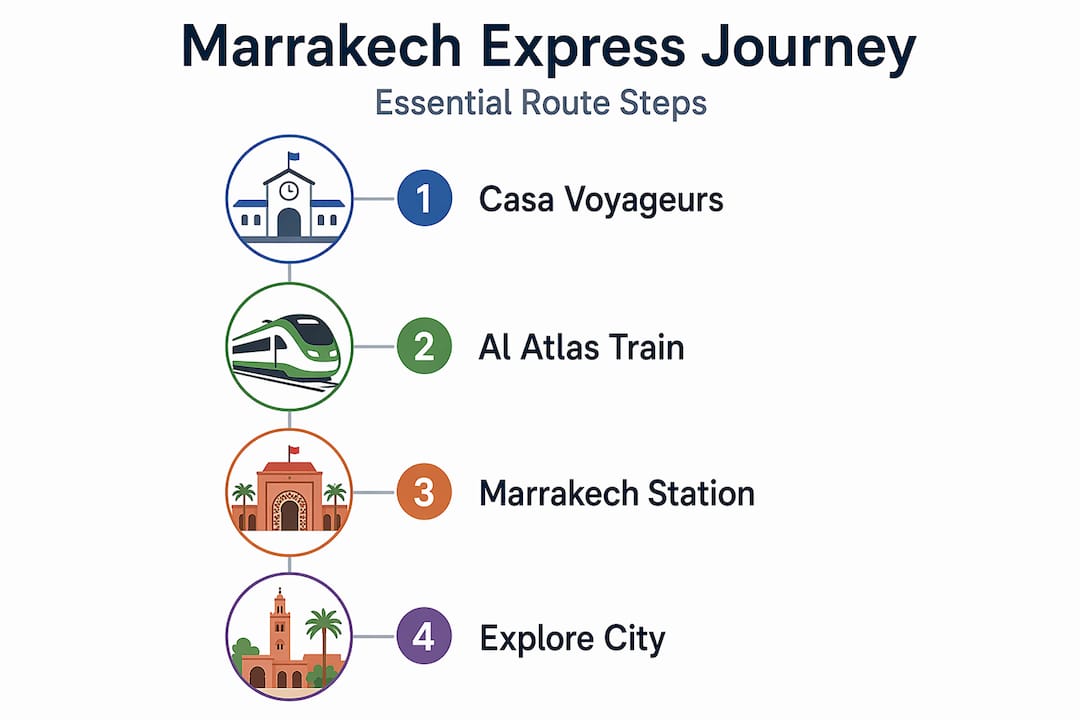
One detail that trips up first-time visitors: Casablanca has multiple train stations. You want Casa Voyageurs, not Casa Port. Casa Port connects to the northern coastal rail lines and does not serve Marrakech-bound trains directly. Arriving at the wrong station costs you time and an unnecessary taxi ride.
On the Marrakech end, trains pull into Marrakech Railway Station in the Ville Nouvelle district. It is clean, manageable, and well-signposted. You are not dropped into chaos; you arrive somewhere organized and easy to exit.
| Route | Train | Duration | Approx. Frequency |
|---|---|---|---|
| Casablanca to Marrakech | Al Atlas (direct) | 2h 40min | Hourly (6 AM to 8 PM) |
| Fes to Marrakech | Overnight couchette | ~8.5 hours | 1 per day (~21:30 depart) |
| Rabat to Marrakech | Via Casablanca | ~3h 45min | Multiple daily |
Pro Tip: If you are traveling from Fes, the overnight couchette train departs around 21:30 and arrives near 06:00, saving you a night’s accommodation while covering significant ground in comfort.
For those planning a broader Moroccan rail itinerary, Topmoroccotravel’s Moroccan train travel guide maps out how to connect these routes logically and efficiently.
Ticket classes, pricing, and booking tips
Understanding the two-class system on Moroccan trains will save you money and set the right expectations before you board.
First class vs. second class
Second-class tickets run 90 to 150 MAD, while first class costs between 150 and 240 MAD. Dynamic pricing applies to both, meaning early bookings typically land at the lower end of those ranges. At the current exchange rate, you are looking at roughly $9 to $24 USD for the full Casablanca to Marrakech journey. That is exceptional value for a nearly three-hour scenic ride.
Here is what actually differentiates the two:
- First class offers six-seat enclosed compartments with more legroom, softer seating, air conditioning, and a quieter ride. It is the right choice for families with young children, travelers with extra luggage, or anyone who wants to work or sleep on board.
- Second class uses open-carriage seating in rows of two or three. It is louder, more social, and gives you direct access to the kind of spontaneous conversations that make travel memorable. Vendors occasionally walk through selling snacks, and the car fills with the sounds and energy of everyday Moroccan life.
- Couchette class (available on the Fes overnight train) includes fold-down berths in a private compartment, running approximately €30 to 40 and genuinely comfortable for overnight travel.
There is no dining car on these trains, so bring food and water before you board.
| Class | Price (MAD) | Seating | Best For |
|---|---|---|---|
| Second class | 90–150 | Open rows | Budget travelers, cultural immersion |
| First class | 150–240 | Closed 6-seat compartment | Families, comfort seekers |
| Couchette (overnight) | ~€30-40 | Fold-down berths | Fes to Marrakech overnight trip |
How to buy your tickets
Booking online is strongly recommended to avoid seat shortages and credit card rejections at station machines. Foreign cards frequently fail at Moroccan ticket kiosks due to security protocols. The ONCF website (oncf.ma) allows advance booking, and several third-party platforms also handle Moroccan rail tickets with English-language interfaces.
Pro Tip: Buy your ticket at least a day in advance if you are traveling during Ramadan, a Moroccan public holiday, or the summer high season. Trains fill quickly, and unreserved second-class seats can disappear fast on popular morning departures.
For travelers combining the rail journey with a guided city experience, the Marrakech to Casablanca tour guide at Topmoroccotravel offers practical trip-building advice alongside route context.
What you actually see and experience on board
Here is the part that most practical travel guides skip entirely. The Casablanca to Marrakech train is not just transportation. It is the opening act of your Morocco experience.
Leaving Casablanca, you pass through the dense urban sprawl of greater Casablanca before the landscape opens into the coastal plains of the Chaouia region. The terrain shifts steadily: flat agricultural land gives way to rocky foothills, red earth, and then the high walls and palm-lined outskirts of Marrakech’s approach. On a clear day, you can spot the snow-capped peaks of the Atlas Mountains long before you arrive. Nothing in the experience compares to that first view of the Marrakech skyline rising from the Haouz Plain.
The cultural immersion is just as real as the scenery. Choosing second class connects you directly with the rhythms of daily Moroccan life. You sit alongside students returning home, traders moving goods, and families on weekend trips. It is noisy, warm, and alive in a way that no organized tour bus replicates. This is the spirit that Graham Nash captured in his song, and it is still present today.
“The true value of Moroccan rail travel lies in affordable scenic exploration and cultural encounters, not luxury branding.”
By contrast, first class is quiet and comfortable. You will not regret choosing it if you need rest or peace. But if you have already done the luxury version of Morocco and want something that feels real, second class is where that happens.
A few sensory details worth knowing before you board:
- The train is air-conditioned in summer, but second-class cars can get warm when crowded
- Snack sellers board at station stops, offering fruit, sandwiches, and Moroccan pastries
- Window seats on the right side of the train heading south offer the best Atlas Mountain views
- The train is generally punctual; delays of more than 15 minutes are uncommon on this route
For travelers curious about how rail travel fits into a bigger Morocco itinerary, the Moroccan imperial cities tour connects Fes, Meknes, and Rabat with helpful train context for each leg.
Arriving in Marrakech and planning what comes next
Getting off the train in Marrakech is a smooth experience if you know what to expect. The station sits in Ville Nouvelle, about 1.5 km from the medina. Taxis waiting outside the station charge roughly €2 for that short ride. Agree on the price before you get in, or insist the driver use the meter. Most drivers are fair, but the tourist-to-local fare gap at train stations is real everywhere in Morocco.
Here is a practical arrival sequence that works well:
- Exit the station through the main entrance and turn right for the official taxi rank.
- Confirm the destination and negotiate the fare before loading your bags.
- Ask to be dropped at your riad’s nearest alley entrance in the medina, not just “Jemaa el-Fna.”
- Set your bags down at your accommodation first before exploring. The medina will exhaust you if you carry luggage through it.
- Eat something. The area around Jemaa el-Fna square has food stalls running from noon, and the Marrakech food tours in this neighborhood are genuinely worth booking for your first evening.
Getting to the Sahara from Marrakech
This is where the train’s reach ends. Morocco’s Sahara Desert is not train-accessible. There is no rail line to Ouarzazate, Merzouga, or the Draa Valley. Travelers heading to the desert from Marrakech rely on three main options: organized multi-day tour packages with private transport, CTM bus services to towns like Ouarzazate, or private driver hire.
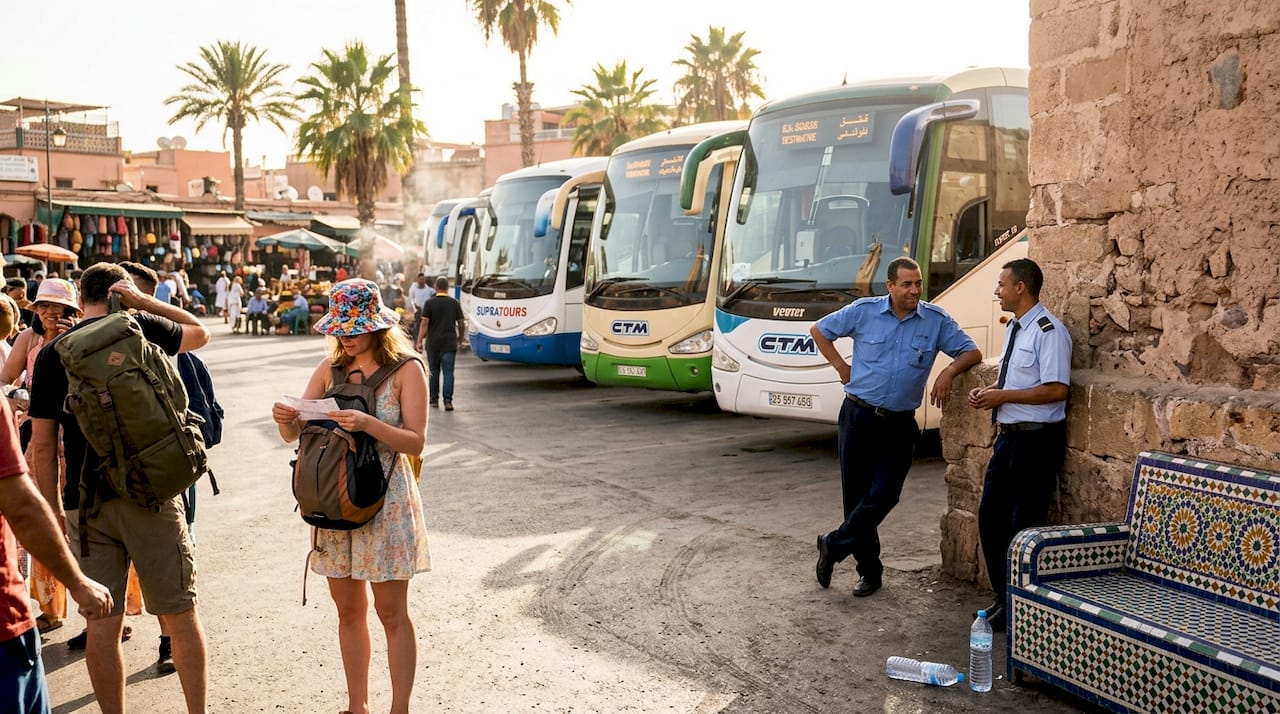
Of these, organized Marrakech desert excursions offer the clearest value. A guided package handles logistics, accommodation, and routing through the Atlas Mountains. Attempting the same trip independently requires renting a car, navigating mountain passes, and managing accommodation in towns with limited English-language booking infrastructure.
Pro Tip: If you want to combine your Marrakech rail arrival with a desert excursion, book the desert tour package before you travel. Departure days from Marrakech are often fixed, and waiting to book on arrival means you may miss your preferred date.
Beyond the desert, Marrakech day trips are genuinely well-supported from the city. The Ourika Valley, Ait Benhaddou, and the Agafay Desert are all within two to three hours by road. The best places to visit in Marrakech itself, including the Bahia Palace, the Saadian Tombs, and the souks of the medina, can fill two full days before you even think about leaving the city limits.
My honest take on the Marrakech Express experience
I have seen travelers arrive in Morocco expecting the Marrakech Express to be a branded heritage train with plush compartments and white-glove service. When they discover the Al Atlas is a clean but ordinary commuter-style train, the initial reaction is mild disappointment.
That reaction fades quickly once the train is moving.
What I have found, after years of watching travelers experience Morocco by rail, is that the people who enjoy this journey most are the ones who stop comparing it to the song or the idea. The charm is not in luxury; it is in the 2 hours and 40 minutes of Morocco sliding past your window before the city reveals itself. It is in the conversation you have with a student who speaks four languages and wants to practice his English. It is in arriving somewhere at ground level, not stepping off a plane into a transfer shuttle.
My honest recommendation: take second class at least once. The price difference from first class is small, but the experiential difference is significant. You might find it uncomfortable. You might love it. Either way, you will remember it.
The other thing I want to be direct about is that Marrakech is not a day-trip city. It is a base. Use the train to get there efficiently, then slow down. The medina rewards the passage of time. The food rewards curiosity. And the surrounding geography, from the Atlas to the Sahara, rewards anyone willing to book a proper excursion rather than cramming it into a rushed Marrakech sightseeing afternoon.
— Topmoroccotravel
Plan your Morocco rail trip with expert support
The Casablanca to Marrakech train gets you to one of North Africa’s most layered cities for less than $25. What happens after you arrive is where the real planning pays off. Topmoroccotravel specializes in building travel programs that use Morocco’s rail network as the spine of a full itinerary, connecting imperial city visits, medina exploration, and Atlas Mountain adventures without the logistical headaches of going solo.
If you are looking at Moroccan city tour concepts that blend cultural depth with comfortable logistics, Topmoroccotravel’s curated packages start from Marrakech and extend outward to every corner of the country. For travelers whose primary goal is reaching the Sahara after the train arrives, the Morocco desert tours section maps out multi-day desert routes departing directly from Marrakech. Experienced guides, private transport, and fixed itineraries mean you focus on the experience instead of the spreadsheet.
FAQ
What exactly is the Marrakech Express?
The Marrakech Express is not an official train service. It is a popular term, largely inspired by a 1969 Crosby, Stills & Nash song, used informally to describe train travel to Marrakech on Morocco’s ONCF rail network.
How long does the Casablanca to Marrakech train take?
The direct Al Atlas train covers the route in approximately 2 hours and 40 minutes, with trains running roughly every hour between 6 AM and 8 PM daily.
Which Casablanca station do I use for Marrakech?
Use Casa Voyageurs, not Casa Port. Casa Port serves northern coastal routes and does not provide direct Marrakech-bound services.
How much does a Marrakech train ticket cost?
Second-class tickets cost between 90 and 150 MAD, and first-class tickets range from 150 to 240 MAD. Prices vary based on how far in advance you book.
Can I reach the Sahara Desert by train from Marrakech?
No. Morocco’s Sahara desert is not reachable by rail. Travelers use organized desert tours with private transport or CTM bus services from Marrakech to reach destinations like Merzouga or Ouarzazate.



Comments are closed