




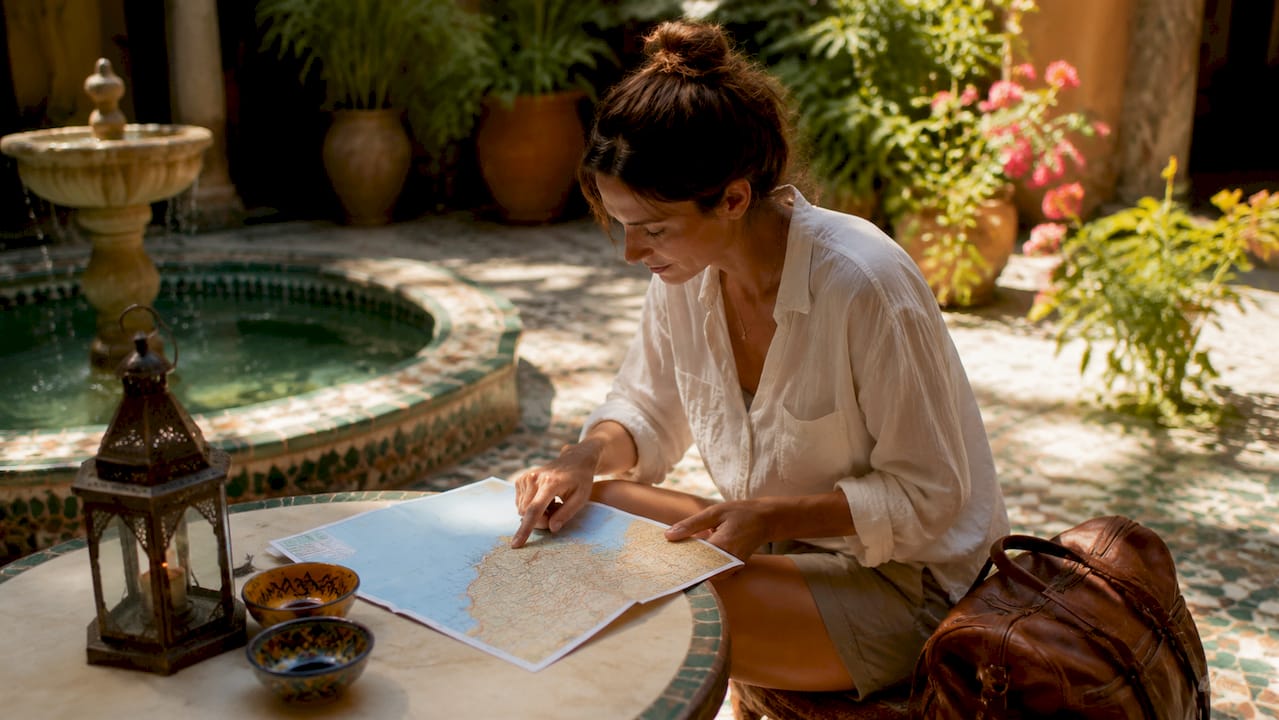
- Trip duration in Morocco determines the geographic scope of your adventure, from Marrakech’s medinas to the Sahara dunes.
- Short trips focus on Marrakech, while longer stays include regions like Fes, Chefchaouen, and the Atlantic coast.
- Planning with realistic travel times and private transport maximizes exploration and minimizes transit fatigue.
Morocco itinerary guides for 3, 5, 7, 10, and 14 days are curated route plans that match your available time to the country’s most rewarding cultural and adventure experiences. Each duration unlocks a different scope of Morocco, from the dense medinas of Marrakech to the silence of the Sahara and the blue-painted streets of Chefchaouen. The core challenge in Morocco trip planning is not finding things to do. It is choosing the right number of destinations for the time you have, so you spend your days exploring instead of sitting in a van on a mountain road.
Morocco itinerary guides 3 5 7 10 14 days: what each trip length actually covers
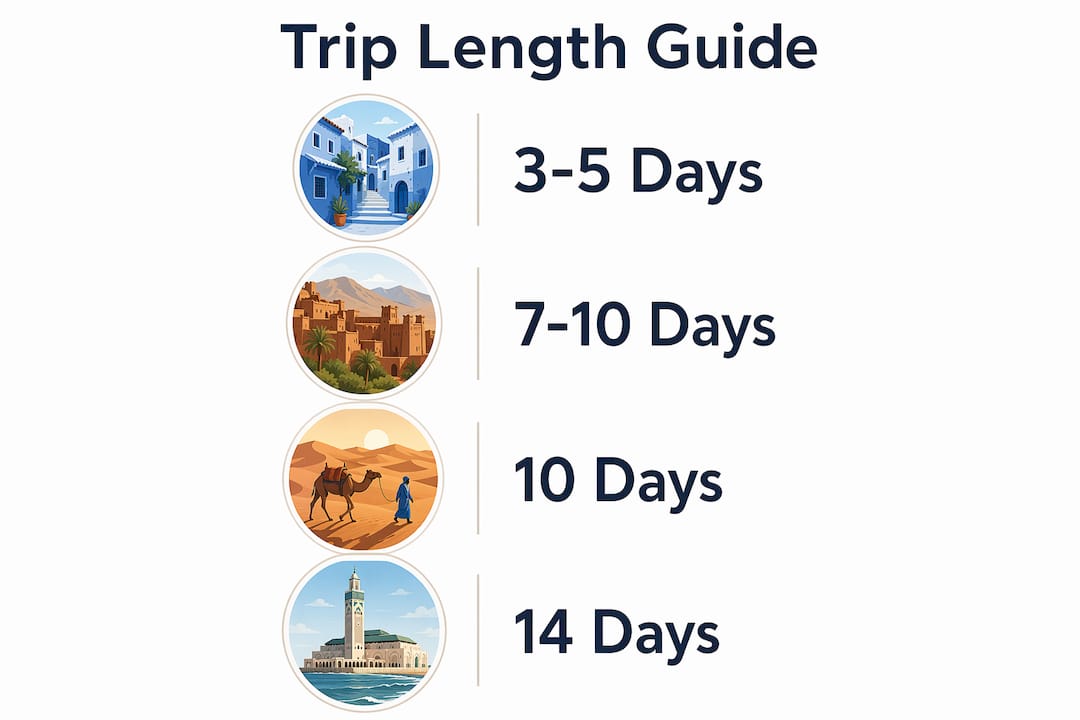
The single most important rule in Morocco travel itinerary planning is this: trip length determines region scope, not just pace. A 3-day trip and a 14-day trip are not the same journey compressed or expanded. They are fundamentally different experiences with different geographic footprints.
Short trips (3–5 days) belong to Marrakech and its immediate surroundings. Medium trips (7–10 days) can reach the Sahara, the Atlas Mountains, and Fes. Long trips (14 days) open up the north, including Chefchaouen, Tangier, and Meknes, plus the Atlantic coast. Understanding this framework before you book flights saves you from the most common mistake travelers make: building an itinerary that looks great on a map but falls apart on the road.
Morocco’s geography is the hidden variable in every trip plan. The country covers roughly 172,000 square miles, and its roads through the Atlas Mountains and desert regions are winding and slow. Even short map distances can translate to 5–8 hours of driving. That reality shapes every itinerary recommendation below.
What can you realistically do in 3 to 5 days in Morocco?
Trips under 5 days should stay in Marrakech and its immediate surroundings to avoid burning your limited time on transit. This is not a limitation. Marrakech alone can fill a week if you let it breathe.
3-day marrakech focus
Three days in Marrakech gives you enough time to cover the city’s core without rushing. A realistic 3-day plan looks like this:
- Day 1: Djemaa el-Fna square, the Koutoubia Mosque exterior, and an evening in the souk
- Day 2: Bahia Palace, the Saadian Tombs, and the Mellah (Jewish quarter)
- Day 3: Majorelle Garden, the Yves Saint Laurent Museum, and a cooking class in the medina
Each of these days is full without being punishing. The key is staying inside the medina or within a short taxi ride of it.
5-day expansion options
Five days lets you add one strong day trip without sacrificing depth in Marrakech. The two best options are the Atlas Mountains (specifically the Ourika Valley or Imlil village) and Essaouira, the coastal port city about 2.5 hours west. Both are doable as single-day excursions from Marrakech. Avoid trying to do both. One day trip plus four days in Marrakech produces a better trip than two rushed day trips.
Adventure options on a short Morocco travel itinerary are limited but real. A half-day hike in the Ourika Valley, a mule trek to the Imlil plateau, or a surf lesson in Essaouira all fit within a 5-day window without disrupting your city time.
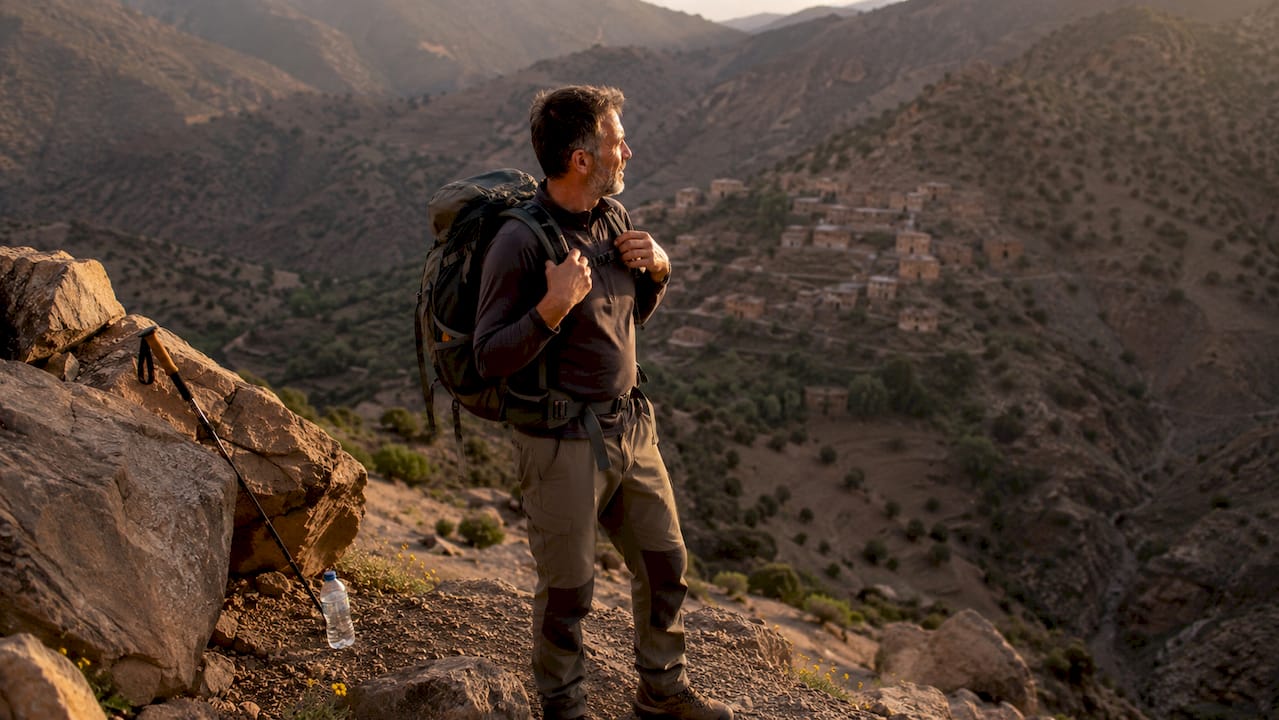
Pro Tip: Book your Marrakech riad for all 5 nights before you arrive. Switching accommodations mid-trip on a short itinerary wastes 2–3 hours you cannot afford to lose.
How does a 7-day Morocco itinerary balance culture and adventure?
Seven days is the minimum for the classic Marrakech-to-Fes loop, but it moves at a brisk pace. This route, often called the Golden Loop, takes you from Marrakech through the High Atlas, into the Draa Valley, across the Sahara dunes at Merzouga, and north through the Ziz Gorges to Fes. It is the most popular Morocco travel itinerary for first-time visitors, and for good reason. It covers the country’s three most distinct landscapes in a single arc.
The table below shows a realistic daily breakdown with approximate driving times:
| Day | Location | Key Activity | Drive Time |
|---|---|---|---|
| 1 | Marrakech | Medina, souks, Djemaa el-Fna | None |
| 2 | Marrakech to Ouarzazate | Tizi n’Tichka pass, Ait Benhaddou | 3–4 hours |
| 3 | Ouarzazate to Merzouga | Draa Valley, Todra Gorge | 5–6 hours |
| 4 | Merzouga (Sahara) | Camel trek, overnight desert camp | None |
| 5 | Merzouga to Midelt | Ziz Gorges, cedar forests | 4–5 hours |
| 6 | Midelt to Fes | Middle Atlas, Ifrane | 3–4 hours |
| 7 | Fes | Fes el-Bali medina, tanneries | None |
The driving days are real. Desert drives can take 8 hours or more due to road conditions and terrain. Day 3 in particular is long. Plan it as a scenic driving day with stops, not a transit day to endure.
Hiring a private 4×4 driver for the Sahara and Atlas segments costs 1,200–1,800 MAD per day but transforms the experience. You stop when you want, get local commentary, and avoid the stress of navigating unmarked desert roads. Public transport works well between Casablanca, Rabat, and Fes, but it cannot serve the desert and mountain segments of this loop.
Pro Tip: Book your Sahara Desert camp at least 6 weeks in advance for spring and fall travel. The best camps at Erg Chebbi near Merzouga sell out fast, and budget camps fill even faster.
Why is 10 days the sweet spot for a Morocco trip?
Ten days is the optimal duration for a Morocco itinerary that covers Marrakech, the Sahara, Fes, and at least one additional destination without feeling rushed. It is the length where you stop managing transit and start actually experiencing the country.
The extra 3 days beyond the Golden Loop give you two meaningful choices. You can head north to Chefchaouen, the photogenic blue city in the Rif Mountains, or you can add Essaouira on the Atlantic coast for a slower, wind-swept counterpoint to the desert. Both options work. Your choice depends on whether you want more cultural immersion or coastal relaxation.
Two strong 10-day itinerary structures
Option A: Marrakech Arrival, Northern Extension
- Days 1–2: Marrakech
- Days 3–4: Atlas Mountains and Ouarzazate
- Days 5–6: Sahara at Merzouga
- Day 7: Drive north through Ziz Gorges
- Day 8: Fes
- Day 9: Chefchaouen
- Day 10: Fly home from Tangier or Fes
Option B: Casablanca Arrival, Coastal Start
- Day 1: Casablanca (Hassan II Mosque, Corniche)
- Day 2: Rabat (Kasbah of the Udayas, Chellah ruins)
- Days 3–4: Fes
- Days 5–6: Sahara via Midelt
- Days 7–8: Marrakech via Ouarzazate
- Day 9: Essaouira
- Day 10: Fly home from Marrakech
Open-jaw flights (flying into one city and departing from another) save 1–2 full days of backtracking. On a 10-day itinerary, that is a significant gain. Flying into Marrakech and out of Fes or Tangier is the most practical combination for Option A.
Key cultural and adventure highlights for 10 days in Morocco:
- Fes el-Bali, the world’s largest car-free urban area
- Ait Benhaddou, a UNESCO World Heritage ksar used in Gladiator and Game of Thrones
- Erg Chebbi dunes at Merzouga, the most accessible Sahara entry point
- Chefchaouen’s blue medina, best explored in early morning before tour groups arrive
- Essaouira’s ramparts and Atlantic surf excursions
High season bookings in spring (March through May) and fall (September through November) require 3–6 months of advance planning, especially for riads and desert camps. Budget roughly $80–$150 per person per night for mid-range riads in Fes and Marrakech and $120–$200 for a quality desert camp experience.
What does a 14-day Morocco itinerary actually allow?
Fourteen days transforms Morocco from a highlights reel into a genuine immersion. Different itinerary lengths serve different traveler goals: 7 days for culture, 10 days for balance, and 14 days for slow-paced adventure and coastal depth. Two weeks lets you add Tangier, Meknes, and multi-day Atlas treks without cutting anything short.
The 14-day framework below builds on the 10-day Golden Loop and adds the north and the coast:
- Days 1–2: Marrakech (medina, palaces, Majorelle Garden)
- Day 3: Ouarzazate and Ait Benhaddou
- Days 4–5: Sahara at Merzouga (camel trek, sunrise dunes, desert camp)
- Day 6: Todra Gorge and drive north
- Days 7–8: Fes (medina, tanneries, Bou Inania Madrasa)
- Day 9: Meknes and the Roman ruins at Volubilis
- Day 10: Chefchaouen
- Day 11: Tangier (Cap Spartel, Hercules Caves, the Kasbah)
- Day 12: Train south to Casablanca or fly to Essaouira
- Days 13–14: Essaouira (ramparts, Gnawa music, surfing, seafood)
The slower pace is the real advantage here. You spend two nights in Fes instead of one, which means you can explore authentic Fes culture beyond the tanneries. You get a full day in Chefchaouen instead of a rushed afternoon. You have time to sit in a cafe in Essaouira and do nothing, which is its own kind of travel.
Multi-day Atlas treks are also possible at this length. The Toubkal Circuit near Imlil takes 2–3 days and reaches the highest peak in North Africa at 13,671 feet. It fits cleanly into a 14-day plan if you swap the Essaouira days for mountain time.
Flight logistics matter more at 14 days. Flying into Marrakech and out of Casablanca or Tangier avoids a brutal return drive and keeps the itinerary flowing in one direction. Advance booking is critical for spring and fall travel, particularly for desert camps and popular riads in Chefchaouen, where accommodation options are limited.
For adventure activities across Morocco, 14 days is the only length that lets you combine desert, mountain, and coastal experiences without sacrificing any of them.
Key takeaways
The best Morocco itinerary matches your trip length to a realistic geographic scope, because transit time is the biggest threat to a satisfying trip.
| Point | Details |
|---|---|
| 3–5 days: stay local | Limit short trips to Marrakech and one day trip to avoid transit fatigue. |
| 7 days: the Golden Loop | Marrakech to Fes via the Sahara works in 7 days but moves fast. |
| 10 days: optimal balance | Ten days cover Marrakech, the Sahara, Fes, and one northern or coastal add-on comfortably. |
| 14 days: full immersion | Two weeks unlocks Tangier, Meknes, multi-day treks, and real coastal time. |
| Private transport is non-negotiable | Hire a private 4×4 driver for desert and Atlas segments to save time and improve the experience. |
What i’ve learned planning Morocco trips across every duration
Most travelers come to us at TopMoroccoTravel with the same instinct: they want to see everything. Marrakech, the Sahara, Fes, Chefchaouen, Essaouira, and Tangier, all in 8 days. I understand the impulse. Morocco is extraordinary, and the fear of missing something real is legitimate.
But trying to see all of Morocco in under 10 days means spending half the trip in transit rather than exploring. I have seen it happen repeatedly. Travelers arrive exhausted on day 3, spend day 5 dreading the next 6-hour drive, and leave feeling like they glimpsed Morocco rather than experienced it.
The trips that generate the best feedback are the ones built around fewer places with more time in each. A traveler who spends three nights in Fes leaves knowing the city. A traveler who spends one night leaves knowing the tanneries. That difference is the whole point of travel.
My honest recommendation: if you have 7 days, do the Golden Loop and do it well. If you have 10 days, add Chefchaouen or Essaouira and use open-jaw flights. If you have 14 days, slow down in the north and let the country reveal itself. And regardless of your duration, budget for a private driver for desert tours. It is the single upgrade that most improves the quality of the trip, and it is far less expensive than most travelers expect.
A successful Morocco trip balances energetic city experiences with slow, immersive desert or coastal time. That balance does not happen by accident. It happens when you plan with realistic expectations about distance, driving time, and what you actually want to feel at the end of the trip.
— Topmoroccotravel.com
Plan your Morocco trip with Topmoroccotravel.com
Topmoroccotravel builds customized Morocco itineraries for every trip length, from 3-day Marrakech escapes to 14-day full-country circuits. Every itinerary is designed around realistic driving times, authentic cultural stops, and the kind of pacing that leaves you energized rather than exhausted. Whether you want a luxury city tour through Marrakech and Fes or a deep desert circuit through the Sahara, the team handles logistics, private transport, riad bookings, and on-the-ground support. Explore the full range of Morocco travel packages on the website, or reach out directly for a personalized itinerary built around your exact travel dates and interests.
FAQ
How many days do you need to see Morocco properly?
Ten days is the minimum for a well-rounded Morocco trip that covers Marrakech, the Sahara, and Fes without rushing. Shorter trips work well if you focus on one region.
Is 7 days enough for Morocco?
Seven days is enough for the classic Golden Loop from Marrakech to Fes via the Sahara, but the pace is fast. Adding northern cities like Chefchaouen is not realistic in 7 days due to long drives.
What is the best time of year to visit Morocco?
Spring (March through May) and fall (September through November) offer the best weather across all regions. Both seasons require booking riads and desert camps 3–6 months in advance.
Do I need a private driver for a Morocco road trip?
A private 4×4 driver is the standard for Sahara and Atlas segments. Public transport works between major cities like Casablanca, Rabat, and Fes but cannot serve desert and mountain routes efficiently.
Can I visit Chefchaouen on a 7-day Morocco itinerary?
Adding Chefchaouen to a 7-day itinerary is not recommended. The northern detour adds significant driving time and compresses the rest of the route. Save Chefchaouen for a 10-day or 14-day trip.



Comments are closed