




- A 7 to 14-day trip offers the ideal balance to explore Morocco’s imperial cities, mountains, desert, and coast comfortably.
- First-time visitors should prioritize 10 days for deeper cultural immersion, while 7 days suffice for a focused highlights tour.
The ideal number of days in Morocco for a first-time visitor is 7 to 14 days, with 10 days representing the most practical balance between coverage and comfort. This range lets you move through the imperial cities of Marrakech and Fes, cross the High Atlas Mountains, sleep under the stars in the Sahara Desert, and still have breathing room between destinations. Squeeze it tighter than seven days and you risk spending more time in a car than in a medina. Stretch it to three weeks and you unlock Morocco’s Atlantic coast, Rif Mountains, and the kind of slow cultural immersion that changes how you travel. Understanding where your trip falls in that spectrum is the first decision every Morocco trip planner needs to make.
How many days do you need in Morocco for a first visit?
Fast-paced travelers can cover Morocco’s highlights in 7 to 8 days moving every one to two nights, while relaxed travelers prefer 10 to 14 days to absorb the culture and enjoy longer stays. That gap matters more than it sounds. Morocco is a geographically large country with road conditions that vary significantly between regions. A drive from Marrakech to Merzouga, the gateway to the Erg Chebbi dunes, takes roughly eight hours. Fes to Chefchaouen is another three hours north. These are not short hops.

The country divides naturally into four distinct zones: the imperial cities of the north and center (Marrakech, Fes, Meknes, and Rabat); the High Atlas Mountains; the Sahara Desert in the southeast; and the Atlantic and Mediterranean coasts. Seeing all four zones in a single trip requires at minimum 10 days. Seven days forces you to choose two or three zones and accept that you are getting a highlight reel rather than a full picture.
For most travelers asking how long to visit Morocco, the honest answer is this: if you have one week, go and make it count. If you have two weeks, you will leave with a fundamentally richer experience. If you have three weeks, Morocco will reward every extra day with something you did not expect to find.
What can you realistically see in 7 days in Morocco?
Seven days in Morocco is enough for a focused, high-impact trip if you commit to a single well-designed circuit. The classic 7-day Golden Loop connects Marrakech, the Atlas Mountains, the Sahara overnight camp at Merzouga, and Fes, with an optional day trip to Chefchaouen from Fes. Here is how that week breaks down in practice:
- Day 1: Arrive in Marrakech. Spend the afternoon in Djemaa el-Fna square and the souks. Recover from travel. Do not try to see everything on arrival day.
- Day 2: Full day in Marrakech. Visit the Bahia Palace, Saadian Tombs, and Majorelle Garden. A full day here is the minimum to feel the city rather than just photograph it.
- Day 3: Drive through the High Atlas to Dades Valley. The Tizi n’Tichka pass and Aït Benhaddou are on this route. Expect five to six hours of driving with stops.
- Day 4: Continue to Merzouga and the Sahara. Arrive by late afternoon for a camel ride into the dunes and an overnight stay at a desert camp.
- Day 5: Sahara sunrise, then drive toward Fes. This is a long transit day of seven to eight hours. Break it in Midelt or Ifrane.
- Day 6: Full day in Fes. The Fes el-Bali medina is a UNESCO World Heritage Site and genuinely requires a full day. The tanneries, Al-Qarawiyyin mosque, and the Bou Inania Madrasa are not quick stops.
- Day 7: Day trip to Chefchaouen or fly home from Fes. Chefchaouen is three hours from Fes, making it a tight but doable day trip before an evening flight.
The Sahara overnight camp is not simply a place to sleep. Allocating at least one overnight in the desert is the single most important scheduling decision in any Morocco itinerary because sunrise and sunset in the dunes are the experiences travelers remember for decades. Booking a camp stay and then skipping the sunrise to save time defeats the entire purpose.
Pro Tip: Do not add more than five distinct destinations to a 7-day Morocco itinerary. Every extra stop costs you a half-day of driving and a half-day of settling in, which means you are never fully present anywhere.
The 7-day loop works best when you accept its constraints. You will not see Essaouira, Tangier, or the Todra Gorge. That is fine. A focused week done well beats a scattered week done poorly.
Why 10 to 14 days is the sweet spot for a more immersive experience
A 14-day Morocco circuit is widely recognized as the ideal duration for first-time visitors who want to cover both northern and southern Morocco at a pace that does not produce exhaustion. The extra days do not just add destinations. They change the quality of every experience you already planned.
With 10 to 14 days, you can spend two nights in Marrakech instead of one, which means a full day of exploration without the pressure of an early checkout. You can add Essaouira, a coastal town three hours west of Marrakech, for a complete change of pace before heading south. You can spend two nights in Fes, which is genuinely the minimum to understand the medina’s geography. And you can include the Todra Gorge or the Draa Valley between the Atlas and the Sahara without turning every day into a transit marathon.
Driving times between regions typically range from three to eight hours depending on the route, and this reality shapes everything about how Morocco trip planning works. Adding buffer days absorbs delays, unexpected discoveries, and the simple human need to sit in a riad courtyard and do nothing for an afternoon.
Here is how the three main trip lengths compare across key dimensions:
| Duration | Regions covered | Pace | Best for |
|---|---|---|---|
| 7 days | Marrakech, Atlas, Sahara, Fes | Fast, 1-2 nights per stop | Travelers with limited vacation time |
| 10 days | Above plus Essaouira or Todra Gorge | Moderate, 2 nights in major cities | First-timers wanting balance |
| 14 days | Full circuit including coast and north | Relaxed, 2-3 nights per stop | Deep cultural immersion seekers |
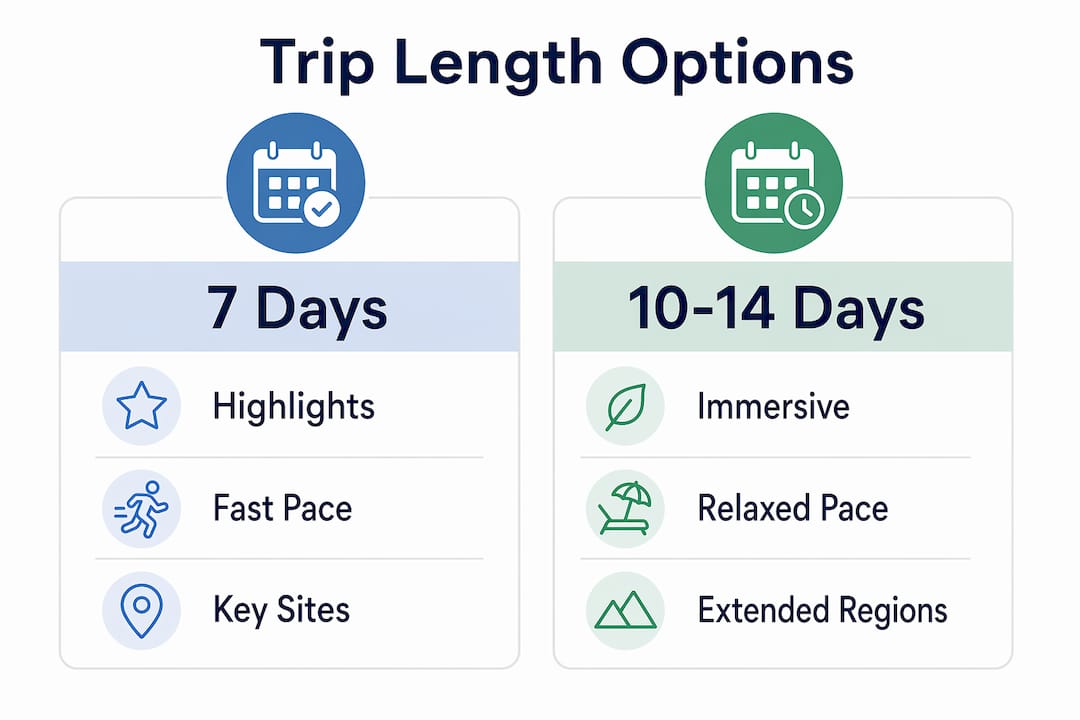
The 10-day option deserves more attention than it typically gets. It hits the threshold where you stop feeling like you are chasing the itinerary and start feeling like you are actually in Morocco. Two nights in Marrakech, two in the Sahara region, two in Fes, and two in a coastal or mountain stop give you a genuinely satisfying trip without requiring three weeks of vacation time.
Pro Tip: If you are choosing between 10 and 14 days, add the extra four days to your existing stops rather than adding new destinations. Two nights in Fes beats one night in Fes plus a rushed visit to Meknes every time.
For travelers considering a detailed 10-day route from Marrakech, Topmoroccotravel has mapped out a pacing structure that accounts for realistic driving times and builds in the kind of rest that makes cultural experiences land properly.
How your travel interests shape the ideal number of days
Lonely Planet’s guidance on Morocco trip duration is direct: the ideal length depends on traveler interests, specifically whether you prioritize mountains, coast, cities, or desert, rather than on any fixed formula. This is the most practically useful framing for anyone trying to finalize their Morocco travel duration.
Your interests determine not just where you go but how long each stop needs to be. Consider how different traveler profiles approach the same country:
- Cultural travelers focused on medinas, architecture, and history need more time in Fes and Marrakech than the average itinerary allocates. The Fes el-Bali medina alone contains over 9,000 streets and alleyways. A single day produces sensory overload. Two days produces orientation. Three days produces genuine understanding. Cultural travelers should add at least two to three extra days to any standard itinerary.
- Adventure seekers prioritizing the Sahara, Atlas trekking, and gorge hiking need to build in travel days specifically around these experiences. A multi-day trek in the Toubkal National Park near Marrakech requires two to four days minimum. Combining Toubkal with a Sahara overnight and Fes pushes the minimum trip length to 10 days.
- Leisure travelers seeking beaches, spas, and slower rhythms gravitate toward Essaouira on the Atlantic coast or Agadir further south. These travelers often find that a 10-day trip split between two or three locations satisfies them more than a seven-city sprint.
- Family travelers with children need to account for shorter attention spans, more rest time, and the reality that medina navigation with a stroller or young children is genuinely challenging. Add two days to whatever length you initially planned.
- Repeat visitors returning to Morocco for a second or third trip often focus on a single region in depth. The Draa Valley, the Rif Mountains around Chefchaouen, or the Souss-Massa region near Agadir each reward a week of focused exploration on their own.
Personalizing trip length based on preferred experiences rather than standard durations produces measurably better travel outcomes. The traveler who spends 10 days in Marrakech, the Atlas, and Essaouira will leave more satisfied than the traveler who spends 10 days trying to see every major city in the country.
Tips to optimize your Morocco trip length and itinerary planning
Effective Morocco itinerary planning comes down to one discipline: protecting your time at the destinations you care about most by being ruthless about transit days.
- Map your driving times before you book anything. The route from Marrakech to Merzouga passes through the Atlas and takes a full day. The route from Merzouga to Fes is another full day. If you have seven days total, two of them are already committed to driving. Plan accordingly.
- Limit major Medina visits to avoid exhaustion. Dedicating full days to key cities like Fes while using day trips for peripheral towns is the approach that experienced Morocco travelers consistently recommend. Spending one night in Meknes and one night in Rabat sounds thorough. In practice, it means two mornings of packing, two afternoons of orienting, and zero depth.
- Use guided tours for efficiency in limited time. A local guide in Fes’s medina covers in three hours what an independent traveler might spend two days trying to find. For travelers with 7 to 10 days, this is not a luxury. It is a time multiplier.
- Build in one buffer day per week of travel. Morocco rewards spontaneity. A carpet weaver’s workshop you stumble into, a local market that only runs on Thursdays, a mountain village that your driver mentions in passing. Buffer days let you say yes to these moments.
- Plan the Sahara overnight with full daylight driving to the camp. Arriving at the dunes after dark means missing the landscape that makes the journey worthwhile. Schedule your Merzouga arrival for late afternoon so you have time for a camel ride before sunset.
Pro Tip: Book your first and last nights in a city with an international airport, typically Marrakech or Casablanca, and build your circuit outward from there. This eliminates the panic of a long drive on departure day and protects your flight.
For travelers who want a ready-made structure, Topmoroccotravel’s Morocco itinerary options cover 7-day, 10-day, and 14-day circuits with driving times, overnight locations, and experience priorities already mapped out.
Key takeaways
The minimum number of days needed in Morocco is 7 for a focused highlights trip, but 10 to 14 days is the standard that delivers genuine cultural depth without exhaustion.
| Point | Details |
|---|---|
| 7-day minimum | Covers Marrakech, Atlas, Sahara, and Fes at a fast but feasible pace. |
| 10 to 14 days is optimal | Adds coastal stops, deeper medina time, and buffer days for a richer experience. |
| Sahara overnight is non-negotiable | At least one desert camp night is required to justify the travel time to Merzouga. |
| Interests determine length | Cultural, adventure, and leisure travelers each need different allocations of time per region. |
| Driving time is the hidden variable | Routes between regions take 3 to 8 hours; failing to account for this ruins pacing. |
What I have learned from watching travelers get Morocco wrong
After years of planning Morocco trips through TopMoroccoTravel, the pattern I see most often is not travelers who went too slow. It is travelers who went too fast and came home feeling vaguely cheated, as if Morocco had been right there but slightly out of reach.
The seven-city-in-seven-days approach is the most common version of this mistake. You can physically do it. You will collect photographs from every major landmark. But you will also spend most of your trip in a car, arrive at each destination tired, and leave before you have figured out where the good food is. The medinas of Fes and Marrakech are not places you understand on first contact. They are places that reveal themselves slowly, over meals and wrong turns and conversations with people who have nowhere to be.
The travelers who come back most satisfied are almost always the ones who chose depth over breadth. They spent three nights in Marrakech and actually learned the difference between the northern and southern souks. They spent two nights at a desert camp instead of one and caught both the sunset and the sunrise. They took a morning in Essaouira to sit at a cafe and watch the fishing boats come in, which is not in any itinerary but is somehow the moment they describe most vividly when they get home.
My honest recommendation is this: if you are choosing between a 7-day trip and a 10-day trip, spend the extra money on the extra three days rather than on a nicer hotel. The experience compounds in a way that a better riad does not. And if you are planning your first Morocco trip, resist the urge to see everything. Morocco is large enough and rich enough that you will come back. The first trip should make you want to.
— Topmoroccotravel.com
Plan your Morocco trip with expert guidance
Topmoroccotravel designs Morocco itineraries for every trip length, from focused 7-day circuits to immersive two-week journeys. Whether you want to prioritize the Sahara, the imperial cities, or the Atlantic coast, the platform’s Morocco travel packages are built around realistic driving times, authentic overnight experiences, and the kind of local knowledge that turns a good trip into an exceptional one. For travelers who want to go deeper into the desert, the Morocco desert tours page covers Sahara overnight options, multi-day excursions, and camp experiences across the Erg Chebbi and Erg Chigaga dune systems. Browse the full range of city tour concepts to match your interests to the right itinerary length before you book.
FAQ
Is 5 days enough to see Morocco?
Five days covers Marrakech and a day trip to the Atlas Mountains or Essaouira, but it is not enough for the Sahara or Fes. Treat a 5-day trip as a Marrakech-focused visit rather than a Morocco circuit.
What is the best itinerary for Morocco in 7 days?
The 7-day Golden Loop connecting Marrakech, the High Atlas, Sahara overnight at Merzouga, and Fes is the most efficient first-timer route. It covers the country’s four main experience types in a single circuit.
How do I plan a Morocco trip without getting overwhelmed?
Start by choosing one anchor experience, either the Sahara, the medinas, or the coast, and build your itinerary outward from there. Limiting yourself to four or five destinations prevents the transit fatigue that ruins shorter Morocco trips.
Can I do Morocco in 10 days without a tour?
Independent travel in Morocco over 10 days is feasible with a rental car and pre-booked accommodations, but a guided tour covers significantly more ground in the same time. Local guides in Fes and Marrakech are particularly valuable for navigating medinas efficiently.
How many days should I spend in the Sahara?
Allocate at least two nights in the Merzouga area to experience both a sunset camel ride and a full sunrise in the dunes. One night is the minimum, but two nights allows for a more relaxed desert experience without the pressure of an early morning departure.




Comments are closed