




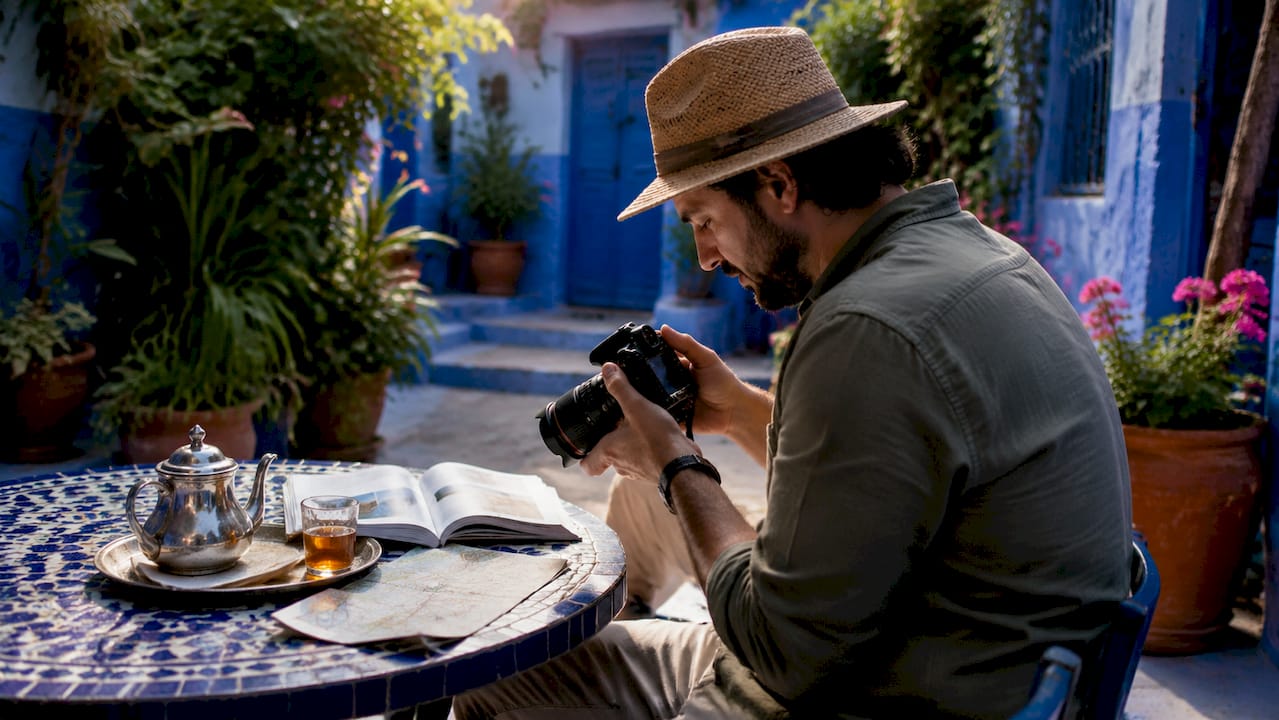
- Morocco offers some of the world’s most photogenic destinations, including blue medinas, deserts, and ancient kasbahs.
- Planning visits carefully for timing, respecting local culture, and understanding each location’s visual style enhances photography results.
- Deep exploration and patience often yield more original photos than rushing through popular sites.
Morocco is home to some of the most photogenic travel destinations on earth, where blue-painted medinas, golden desert dunes, and centuries-old kasbah fortresses create a visual range that few countries can match. The best Morocco Instagram spots span Chefchaouen, Marrakech, Aït Ben Haddou, and the Sahara, each offering a completely different color palette and architectural mood. Over 80% of Moroccan internet users are active on Instagram and Facebook. That statistic tells you exactly why travel photographers are flooding these locations and why getting there early, with a plan, matters more than ever.
What are the top Morocco Instagram spots?
Chefchaouen, Marrakech, Aït Ben Haddou, and the Sahara dunes consistently rank as Morocco’s top photography destinations travel roundups. Each location delivers a signature visual style that photographs differently and tells a distinct story on your feed.
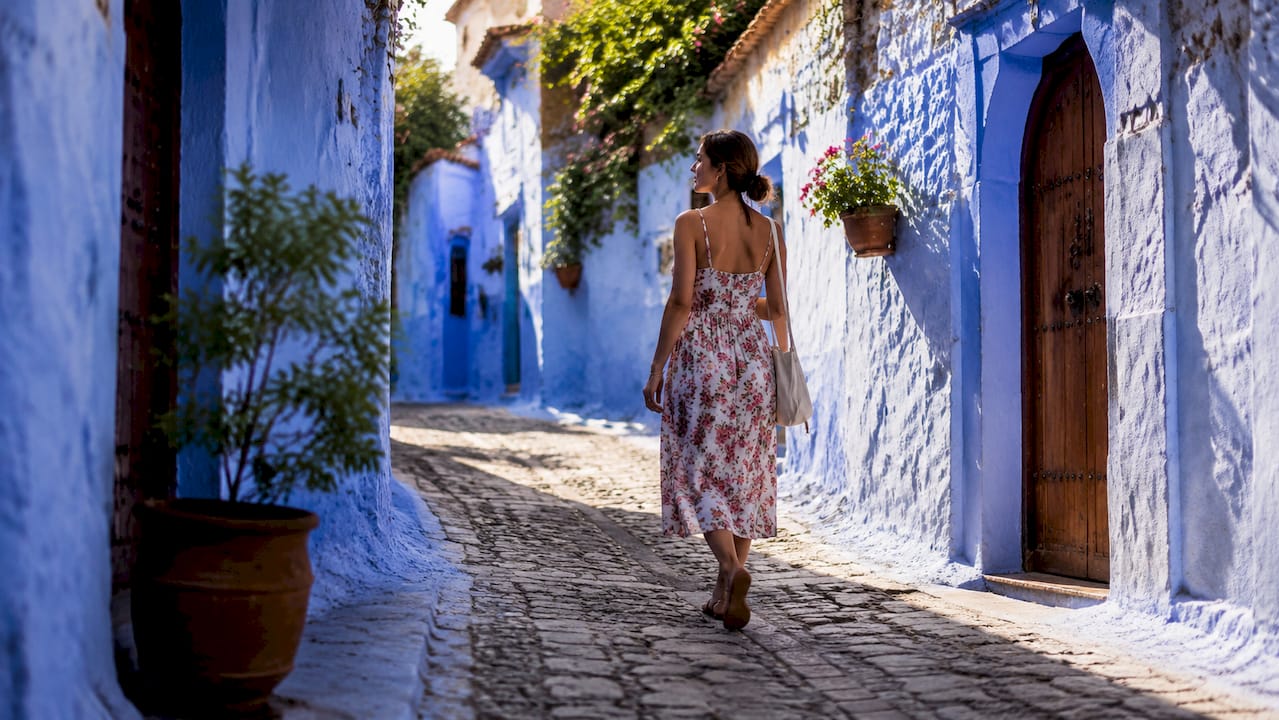
Chefchaouen is the blue city of northern Morocco, where nearly every alley, staircase, and doorway is painted in shades of cobalt and sky blue. The Chefchaouen medina sits against the Rif Mountains, giving you a rare combination of urban color and dramatic natural backdrop in a single frame. Rue Targui, the Spanish Mosque viewpoint, and Place Uta el-Hammam are the three anchor shots every photographer targets here.
Marrakech offers the widest variety of any single city. The top Marrakech Instagram spots include Bab Agnou, Bahia Palace, Koutoubia Mosque, Ben Youssef Madrasa, Jemaa el-Fna Square, and Jardin Majorelle. That is six completely different visual environments within one city. Jardin Majorelle alone, with its cobalt blue structures and vivid yellow pots set against tropical greenery, produces some of the most shared travel photos in North Africa.
Aït Ben Haddou is a UNESCO World Heritage Site designated in 1987. Its golden earthen towers rise from a dry valley floor in a way that looks like a film set, which is exactly why productions like Gladiator and Game of Thrones filmed there. The warm, monochromatic tones of the kasbah photograph best in the late afternoon when the sun angles low across the clay walls.
Beyond these three anchors, Morocco’s photography map extends further:
- Erg Chebbi in the Merzouga region delivers the classic Sahara shot: rippled orange dunes stretching to the horizon with no human structure in sight.
- Fez offers the Chouara Tannery, one of the most recognizable overhead shots in travel photography, where circular stone vats filled with colored dye create a natural mosaic.
- Essaouira gives you a coastal medina with blue and white walls, fishing boats, and Atlantic light that is softer and cooler than inland Morocco.
- Rabat provides the Kasbah of the Udayas, a 12th-century fortress with blue and white streets that rival Chefchaouen but with far fewer tourists.
| Location | Visual Signature | Best Shot |
|---|---|---|
| Chefchaouen | Blue alleys, mountain backdrop | Rue Targui at sunrise |
| Marrakech | Palaces, souks, cobalt garden | Jardin Majorelle midday |
| Aït Ben Haddou | Earthen kasbah towers | Late afternoon valley view |
| Erg Chebbi | Golden dunes, open Sahara | Sunrise or sunset from dune crest |
| Fez | Tannery-colored vats, medina rooftops | Overhead from tannery terrace |
| Essaouira | Coastal medina, fishing harbor | Blue boats at golden hour |
How to capture Morocco photography spots at the right time
Timing is the single biggest factor separating a great Morocco travel photo from a mediocre one. Crowds and harsh midday light are your two main obstacles, and both are solvable with a structured plan.
Chefchaouen requires the earliest start of any location in Morocco. Arriving before 8 AM gives you soft, diffused morning light and near-empty streets. Queues for the most iconic blue alley shots form between 10 AM and 6 PM, which means a 6–7 AM arrival gives you a window of roughly 5–10 minutes of near-empty streets at each key spot before day-trippers arrive. Build a shot list in advance and sequence your locations to minimize backtracking. Start at Rue Targui, move to Place Uta el-Hammam, then climb to the Spanish Mosque viewpoint before the light gets harsh.
Pro Tip: In Chefchaouen, book a room inside the medina rather than outside the city walls. Staying inside means you can step out at 6 AM without a 20-minute walk, and you can return for a second shoot in the evening after day-trippers leave.
Marrakech photography works best in two windows: early morning before 9 AM in the souks and golden hour from 5–7 PM at Jemaa el-Fna square. The souks are genuinely dark and atmospheric in the morning before the crowds arrive, and the light filtering through the woven reed ceiling creates natural spotlighting. Jardin Majorelle opens at 8 AM and fills up fast. Arrive at opening time and head directly to the back garden structures before the central fountain area gets crowded.
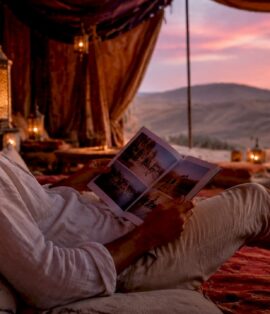
The Sahara operates on a completely different schedule. Sunrise and sunset at Erg Chebbi are the only two times worth shooting. The dunes shift from deep orange to pale gold to near-white across the day, and the dramatic shadow lines that make dune photography compelling only appear when the sun is low. A luxury desert camp positions you directly at the dune base, which means you can walk to the crest in 15 minutes for sunrise without any logistics.
- Arrive in Chefchaouen the evening before your shoot day and walk the medina to identify your exact shot locations.
- Set your alarm for 5:30 AM and be at your first location by 6:00 AM.
- Shoot Chefchaouen until 9:00 AM, then have breakfast and rest.
- In Marrakech, hit the souks first thing in the morning, then Bahia Palace, then Jardin Majorelle at opening time.
- For the Sahara, plan your camp arrival for late afternoon so you catch sunset on your first evening.
- At Aït Ben Haddou, arrive in the early afternoon and stay until the light goes golden at 4–5 PM.
What photography etiquette should you follow in Morocco?
Respectful photography in Morocco is both a cultural obligation and a practical strategy. Asking permission before photographing people is the standard expectation in medinas, souks, and rural areas. The phrase “Mumkin taswira?” translates to “May I take a photo?” and using it consistently builds goodwill and often results in warmer, more natural expressions from your subjects.
The rules around specific locations are clear:
- Mosques: Non-Muslims cannot enter most Moroccan mosques. The Koutoubia Mosque in Marrakech and the Hassan II Mosque in Casablanca are best photographed from the exterior. Shoot from a respectful distance and avoid pointing your camera directly at worshippers.
- Tanneries: The Chouara Tannery in Fez and similar sites in Marrakech are best photographed from rooftop terraces of the surrounding leather shops. Access is typically granted when you browse or purchase from the shop. This is a fair exchange and the standard local norm.
- Royal palaces and police stations: Photography of these sites is legally restricted. The Royal Palace in Fez and Marrakech’s Dar el-Makhzen are off-limits for photography. Do not point your camera at uniformed officers or government buildings.
- Medina crowds: Avoid shooting identifiable faces of strangers in motion without permission. Focus on architectural details, doorways, textiles, and hands at work. These shots are often more compelling than portraits and carry zero privacy risk.
Pro Tip: Carry a small amount of local currency to purchase something small from a shop before asking to use their rooftop. This simple gesture removes friction, creates a genuine interaction, and almost always results in access plus a friendly local guide pointing out the best angle.
Asking permission does more than respect local norms. It produces better photographs. A subject who has agreed to be photographed looks directly at you, relaxes their posture, and often creates a candid moment that a stolen shot never captures.
How do Morocco’s visual styles create a cohesive photo series?
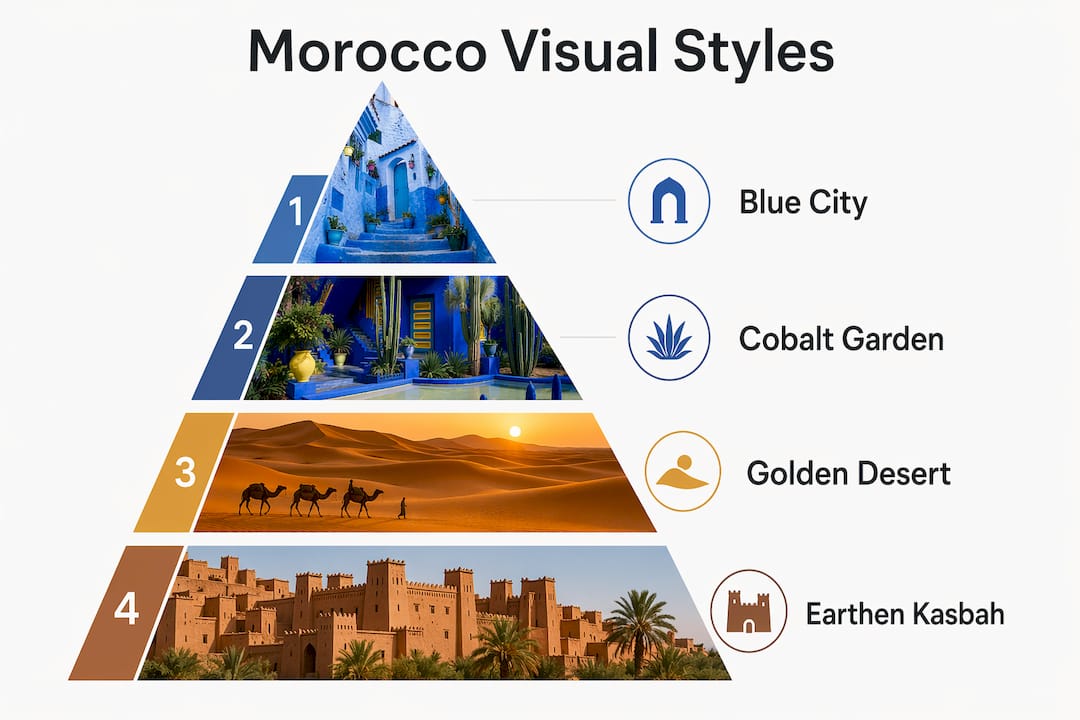
Morocco’s distinct visual signatures divide cleanly into four aesthetic categories, and understanding them lets you plan a feed that tells a coherent visual story rather than a random collection of travel snaps.
The blue city aesthetic is anchored in Chefchaouen. Azure walls, cobalt doorways, and the pale blue of the Rif Mountains in the background create a monochromatic palette that photographs consistently across any time of day. Pair this with white linen clothing or neutral tones to make the blue pop without competing colors in the frame.
The Cobalt Garden aesthetic belongs to Jardin Majorelle in Marrakech. The garden was designed by French painter Jacques Majorelle in the 1920s and later restored by Yves Saint Laurent. The specific shade of cobalt blue used on the structures is now called Majorelle Blue. It is a deeper, more saturated blue than Chefchaouen, and it contrasts sharply with the vivid yellows, oranges, and greens of the surrounding plants.
The Golden Desert Aesthetic covers Erg Chebbi, Erg Chigaga, and the Draa Valley. These locations share a minimal, warm palette of amber, gold, and deep shadow. The visual language is about scale and emptiness. A single figure on a dune crest, a camel silhouette at sunset, or a lone tent in a sea of sand all work because the frame is otherwise uncluttered.
The Earthen Kasbah Aesthetic is defined by Aït Ben Haddou and the southern kasbahs of the Draa Valley. The color palette is terracotta, ochre, and sand. The textures are rough and layered. This aesthetic pairs well with traditional Moroccan clothing in warm tones and works best in late afternoon light when shadows carve depth into the mud-brick walls.
| Visual Style | Key Locations | Color Palette | Best Pairing |
|---|---|---|---|
| Blue City | Chefchaouen, Rabat Kasbah | Azure, cobalt, white | Neutral or white clothing |
| Cobalt Garden | Jardin Majorelle, Marrakech | Majorelle blue, yellow, green | Bold accent colors |
| Golden Desert | Erg Chebbi, Erg Chigaga, Draa Valley | Amber, gold, deep shadow | Minimal, warm tones |
| Earthen Kasbah | Aït Ben Haddou, Draa Valley kasbahs | Terracotta, ochre, sand | Traditional warm textiles |
Combining two or three of these aesthetics across a single trip creates a feed with visual variety and geographic depth. The transition from blue city to golden desert to earthen kasbah reads as a journey, which is exactly the kind of storytelling that performs well on Instagram.
Key takeaways
Morocco’s most photogenic locations reward photographers who plan their timing, respect local culture, and understand the distinct visual language of each region.
| Point | Details |
|---|---|
| Prioritize early arrivals | Shoot Chefchaouen before 8 AM and Marrakech souks before 9 AM to avoid crowds. |
| Know the four visual styles | Blue city, cobalt garden, golden desert, and earthen kasbah each require different approaches. |
| Ask permission every time | “Mumkin taswira?” builds trust and produces better, more natural photographs. |
| Use rooftops strategically | Tannery and souk rooftop access unlocks the most iconic overhead angles in Fez and Marrakech. |
| Match locations to your feed | Plan a visual sequence across Chefchaouen, Marrakech, and the Sahara for a cohesive travel story. |
What i’ve learned photographing Morocco over many trips
The most common mistake I see photographers make in Morocco is rushing. They arrive in Chefchaouen at 10 AM, find the blue streets packed, grab a few shots with strangers in the frame, and leave disappointed. The location did not fail them. The plan did.
My strongest Morocco images came from the moments I slowed down and stayed in one spot longer than felt comfortable. The light in the medinas changes fast. A cloud passing over the Rif Mountains shifts the entire mood of a Chefchaouen alley in under a minute. If you are already packed up and moving to the next spot, you miss it.
The lesser-known locations consistently outperform the famous ones for originality. Rabat’s Kasbah of the Udayas gives you Chefchaouen-style blue and white streets with almost no competition for angles. The Draa Valley between Ouarzazate and Zagora has kasbah architecture that rivals Aït Ben Haddou but sees a fraction of the visitors. Essaouira’s ramparts at sunset produce Atlantic light that Marrakech cannot match.
The cultural etiquette piece is not just about being polite. It is about access. The photographers who get the best shots in Moroccan medinas are the ones who spent 10 minutes talking to a shopkeeper before asking to use the roof. That conversation opens doors, literally and figuratively, that no amount of technical skill can substitute for.
My honest advice: spend more days in fewer places. Three full days in Chefchaouen will produce better work than one day each in six cities. Morocco rewards depth over breadth, and your Instagram feed will reflect that.
— Topmoroccotravel.com
Plan your morocco photography trip with expert guidance
Capturing Morocco’s best photography locations requires more than a camera and a flight. Timing, local access, and knowledge of which spots reward patience are the real variables. Topmoroccotravel.com specializes in building itineraries around exactly these priorities, from guided tours of Morocco that sequence Chefchaouen, Marrakech, and the Sahara for optimal light and crowd avoidance to desert excursions that position you at Erg Chebbi for sunrise. If you want rooftop access in Fez, a private guide into Bahia Palace before the crowds arrive, or a tailored Morocco tour built around your shot list, Topmoroccotravel’s team handles the logistics so you focus on the photography.
FAQ
What is the most Instagrammable city in Morocco?
Chefchaouen is widely considered the most Instagrammable city in Morocco, known for its blue-painted medina streets and Rif Mountain backdrop. Marrakech runs a close second with its palaces, souks, and Jardin Majorelle.
When is the best time to photograph Chefchaouen?
The best time to photograph Chefchaouen is between 6 AM and 8 AM, before day-trippers arrive and while the morning light is soft. Crowds build significantly after 10 AM and make crowd-free shots nearly impossible.
Can you photograph inside mosques in Morocco?
Non-Muslims cannot enter most Moroccan mosques, so interior photography is not an option at sites like Koutoubia Mosque in Marrakech. Exterior shots from a respectful distance are permitted and can be visually compelling.
How do you get rooftop access at the Fez tanneries?
Rooftop access at the Chouara Tannery in Fez is typically granted through the leather shops that surround the tannery. Browsing or purchasing from a shop is the standard exchange for access to their terrace viewing area.
What are the hidden gem photography spots in Morocco?
Rabat’s Kasbah of the Udayas and the Draa Valley kasbahs are two of Morocco’s most underrated photography locations. Both offer visual quality comparable to the famous sites with significantly fewer tourists competing for angles.


Comments are closed