




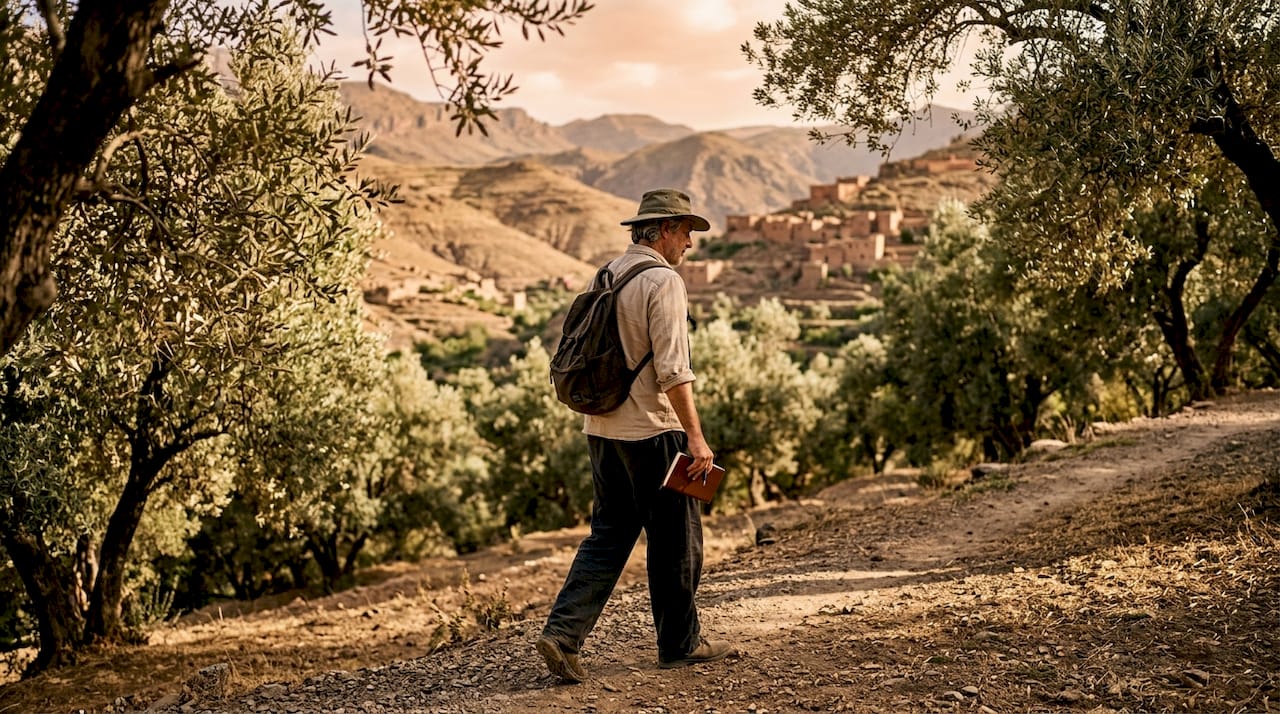
- Many quiet towns and coastal villages in Morocco offer authentic experiences away from crowded cities.
- These destinations have fewer tourists due to limited infrastructure and accessibility but provide genuine cultural interactions.
- Visitors who plan deliberately, travel slowly, and stay longer can enjoy a more immersive and less crowded Moroccan experience.
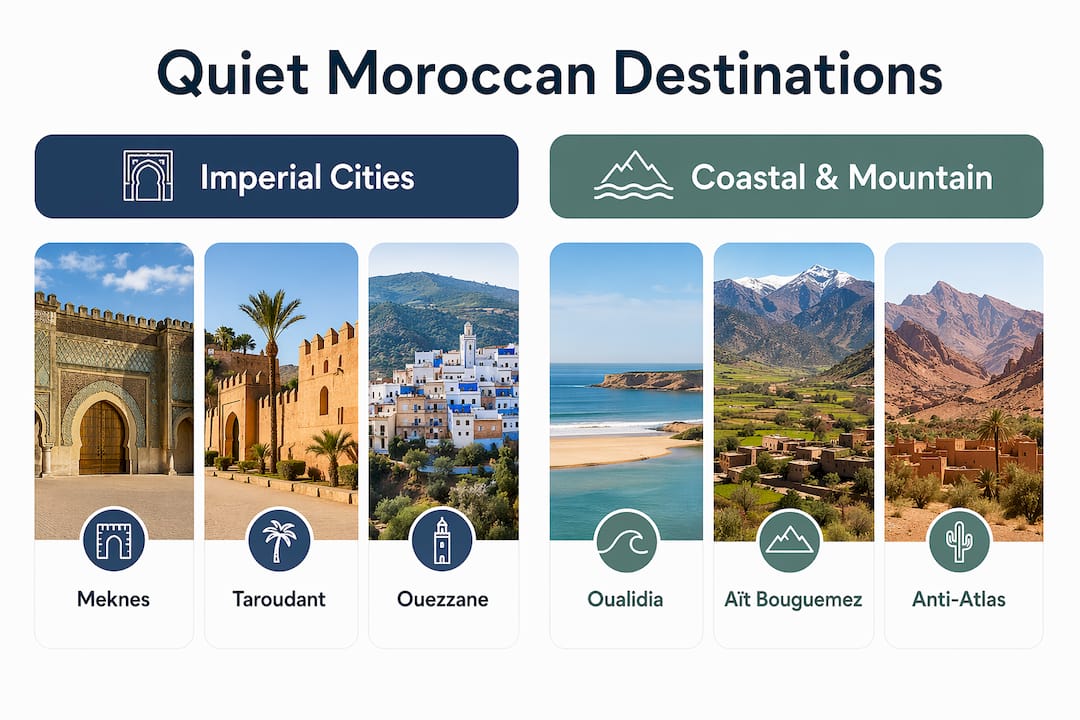
Morocco’s best-kept travel secret is not a single city. It is a collection of quiet towns, coastal villages, and mountain valleys that most travelers fly past on their way to Marrakech or Fez. The best places in Morocco away from the crowds include Meknes, Oualidia, Taroudant, Aït Bouguemez, and Ouezzane. These destinations offer genuine Moroccan life without tour groups, selfie crowds, or inflated prices. Travelers who choose these spots return home with something the popular cities rarely deliver: real connection to a place and its people.
Which lesser-known Moroccan destinations offer the fewest tourists?
Destinations like Oualidia and Taroudant experience 50–70% less tourist foot traffic than major hubs like Marrakech and Chefchaouen. That gap is not a coincidence. These towns lack the Instagram fame of the blue city or the Djemaa el-Fna square, which is exactly what makes them worth visiting.
Here is a breakdown of the quietest destinations and what each one offers:
- Meknes: Often called Morocco’s forgotten imperial city, Meknes sits between Fez and Rabat. Its medina is a UNESCO World Heritage Site with far fewer crowds than Fez. The Bab Mansour gate and the Moulay Ismail Mausoleum are genuinely impressive, and you can walk the souks without being followed by touts.
- Taroudant: Called “little Marrakech” by locals, Taroudant sits inside well-preserved red walls in the Souss Valley. The pace is slow, the market is local, and the Atlas Mountains frame the horizon. Travelers use it as a base for the Anti-Atlas range.
- Oualidia: This small coastal lagoon town sits between Casablanca and Agadir. It is famous for oysters and calm waters. Moroccan families vacation here, but international tourists rarely make the detour. The result is an authentic seaside atmosphere without resort prices.
- Moulay Bousselham: A fishing village north of Rabat on the Atlantic coast. The Merja Zerga lagoon nearby is one of West Africa’s most important bird sanctuaries. Flamingos, spoonbills, and herons gather here in large numbers, yet the town sees a fraction of the visitors that Essaouira attracts.
- Sidi Kaouki: Twelve miles south of Essaouira, this surf village has a handful of guesthouses and a long, windswept beach. It draws kite surfers and travelers who want the Atlantic coast without the crowds of Essaouira’s medina.
- Aït Bouguemez: Known as the “Happy Valley,” this High Atlas valley sits at roughly 6,200 feet in elevation. It is accessible by road from Azilal but requires commitment. The reward is terraced fields, traditional Berber villages, and trekking routes that see a fraction of the traffic on the Toubkal circuit.
- Tafraoute: Deep in the Anti-Atlas, Tafraoute is surrounded by pink granite boulders and almond orchards. The town is small, the guesthouses are family-run, and the light in late afternoon turns the rocks a deep amber.
- Ouezzane: Ouezzane offers quiet streets and winding lanes ideal for travelers wanting to avoid tourist crowds. It is best visited in spring or during the olive harvest season in autumn, when the surrounding hills are active with local life.
Pro Tip: Pack a physical map of the region you plan to visit. Cell coverage in the High Atlas and Anti-Atlas is unreliable, and GPS estimates on mountain roads are consistently optimistic.
| Destination | Type | Best For |
|---|---|---|
| Meknes | Imperial city | History, medina walks |
| Oualidia | Coastal lagoon | Seafood, calm beaches |
| Taroudant | Walled town | Markets, Atlas access |
| Aït Bouguemez | Mountain valley | Trekking, Berber culture |
| Sidi Kaouki | Surf village | Atlantic coast, quiet stays |
| Ouezzane | Hill town | Olive groves, slow travel |
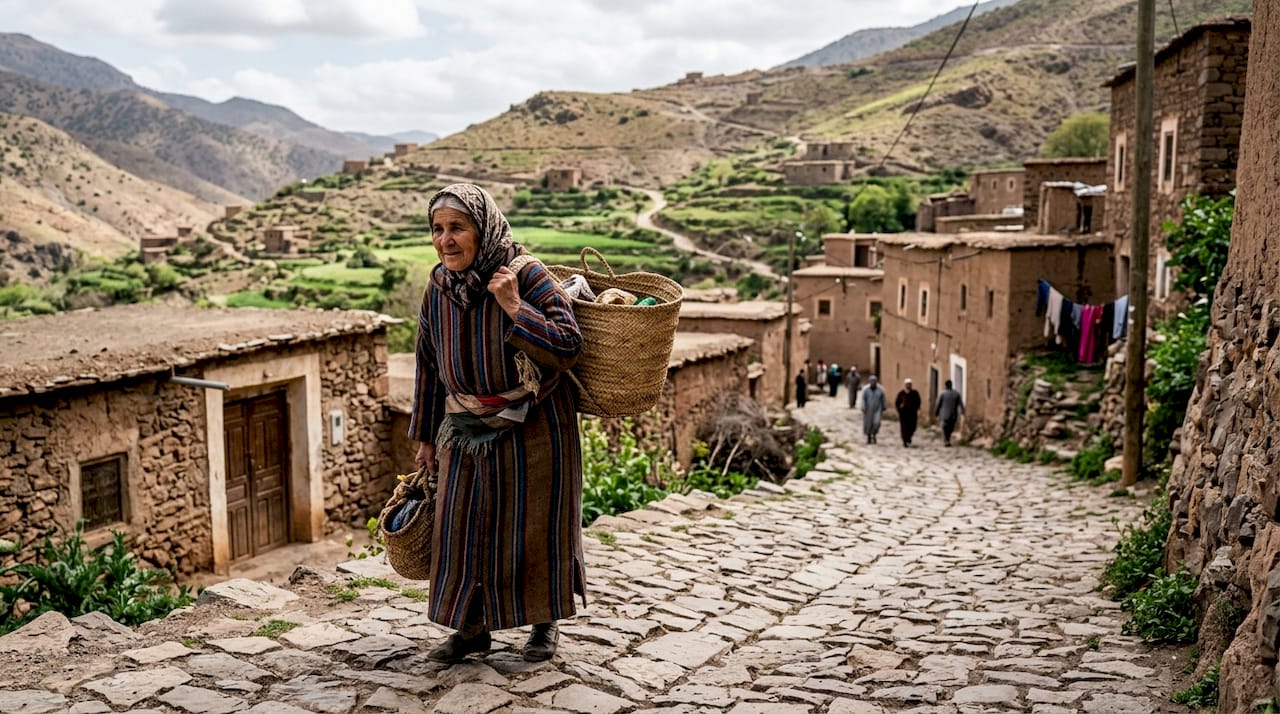
Why do these off-the-beaten-path spots have fewer crowds?
Geography and infrastructure are the two main reasons these destinations stay quiet. Marrakech has a major international airport. Chefchaouen has a social media identity. The towns listed above have neither, and that filters out the casual visitor immediately.
Seasonality also plays a major role. Spring (march–may) and autumn (september–november) are the ideal windows for visiting rural Moroccan regions. Summer heat in inland areas like Taroudant and the Draa Valley regularly exceeds 104°F, which discourages all but the most determined travelers. Winter in the High Atlas brings snow that closes some mountain roads entirely.
The practical barriers to visiting these places also keep numbers low:
- Shared taxis, called grand taxis, depart only when full, which means wait times are unpredictable.
- Mountain roads add significant travel time compared to what any mapping app predicts.
- Accommodation options are limited and rarely bookable on major platforms.
- English is spoken less frequently than in Marrakech or Fez.
These are not problems. They are filters. The travelers who push through them find places that feel genuinely Moroccan rather than curated for foreign consumption.
Pro Tip: Travel in spring if you can. The wildflowers in the Atlas foothills, the mild temperatures, and the post-rain green of the valleys make March through May the most visually rewarding time to visit rural Morocco.
The traveler patterns that drive crowds to Marrakech and Fez are also self-reinforcing. Tour operators build itineraries around airports and famous medinas because they are easier to manage. Travelers follow those itineraries because they are easy to find. Breaking that loop requires a deliberate choice to plan beyond the obvious.
How can you plan a crowd-free Morocco itinerary?
A 7–10 day itinerary with a mid-range budget of $500–$900 USD, excluding flights, is the practical framework for exploring quieter Morocco. That budget covers guesthouses, shared transport, food at local restaurants, and entrance fees without cutting corners.
The single most effective planning decision is to focus on one region per trip. Choosing one core region reduces travel fatigue and improves your chances of genuine community interactions. Trying to cover Chefchaouen, the Sahara, Essaouira, and the High Atlas in ten days means spending most of your time in transit and not actually present.
A practical crowd-free itinerary looks like this:
- Arrive in Casablanca or Agadir. Skip the overnight in a major city. Take a grand taxi or bus directly to your first quiet destination the same day.
- Spend three nights in one town. Oualidia, Taroudant, or Moulay Bousselham each reward a multi-night stay. One day to orient, one day to explore, one day to slow down and actually talk to people.
- Move to a mountain or inland destination. Aït Bouguemez, Tinghir, and Tafraoute each require a full travel day. Build that day into the plan rather than treating it as wasted time.
- Stay in a rural guesthouse or homestay. Rural homestays in the Atlas and Rif Mountains facilitate sustainable tourism and connect travelers directly to Berber traditions. Book through the guesthouse directly, not through a third-party platform.
- Add one buffer day per five days of travel. Shared taxis wait to fill. Roads take longer than expected. A buffer day is not a luxury. It is a requirement for remote travel in Morocco.
- Leave one full day before departure. Use it to return to a transport hub without stress. Rushing to catch a flight from a mountain village is a common and avoidable mistake.
Pro Tip: Pack light enough to carry your bag onto a grand taxi without needing the trunk. Luggage stored in the trunk of a shared taxi sometimes arrives at the destination separately from you.
Budget travelers can reduce costs further by eating at local restaurants called snack restaurants rather than tourist-facing cafes. A full meal of harira soup, bread, and a tagine costs well under $5 in most small towns. Accommodation in rural guesthouses averages $20–$40 per night for a private room with breakfast included.
What cultural experiences await in Morocco’s quieter regions?
The cultural depth available in rural Morocco is not available anywhere in Marrakech’s medina, regardless of how authentic the tour description sounds. Locations like Tinghir reward visitors who stay multiple nights by revealing daily life rhythms like bread-making and oasis walks. These are not performances. They are simply what happens when you are present long enough to be included.
The specific activities available in quieter regions include:
- Bread-making with a host family. Moroccan bread, called khobz, is baked fresh twice daily in most rural households. Participating in the process is a common offering in Atlas homestays.
- Farm visits and harvest participation. Olive harvests in autumn, almond blossoms in February, and saffron harvests in the Taliouine region each offer a window into agricultural Morocco that no city tour replicates.
- Mud-brick construction. Traditional earthen architecture is still actively built and maintained in the Draa Valley and southern regions. Authentic rural experiences like mud-brick making are arranged locally via guesthouses rather than online booking platforms.
- Oasis walks and water management. The ancient irrigation systems called khettara in the pre-Saharan south are engineering feats that most travelers never see. A local guide from your guesthouse can walk you through an active system.
“The texture of a place only reveals itself to those who stay long enough to become slightly bored. That moment of boredom is when the real Morocco begins.” — A sentiment shared widely among long-term travelers to the region.
Rural homestays not only support local economies but also deepen travelers’ cultural understanding through slow, immersive experiences. The money you spend at a family-run guesthouse in Aït Bouguemez stays in that valley. The money spent at a Marrakech riad chain does not.
Patience is the one skill that determines whether a trip to rural Morocco succeeds or frustrates. Schedules shift. Meals arrive when they are ready. Conversations take time to develop. Travelers who accept that rhythm consistently describe these trips as the most memorable of their lives. Travelers who fight it consistently describe them as chaotic.
Key Takeaways
Morocco’s quietest and most authentic destinations reward travelers who plan deliberately, travel slowly, and stay long enough to be present rather than just passing through.
| Point | Details |
|---|---|
| Top quiet destinations | Meknes, Oualidia, Taroudant, Aït Bouguemez, and Ouezzane offer far fewer crowds than Marrakech or Fez. |
| Best travel seasons | Spring (march–may) and autumn (september–november) offer moderate temperatures and the most authentic local atmosphere. |
| Itinerary structure | A 7–10 day trip focused on one region with buffer days built in is the most effective approach for rural Morocco. |
| Accommodation choice | Rural homestays and family guesthouses provide cultural depth and directly support local communities. |
| Cultural access | Activities like bread-making, farm visits, and oasis walks are arranged through local hosts, not online platforms. |
What I have learned from Morocco’s quieter roads
The most common mistake I see travelers make is treating Morocco’s quiet destinations as a checklist item between Marrakech and the Sahara. They spend one night in Taroudant, take a few photos of the walls, and move on. They leave thinking they have seen it. They have not.
The places that changed how I think about travel in Morocco were not the famous ones. Sitting in a courtyard in Ouezzane while an elderly man explained the olive harvest calendar in a mix of Darija and French taught me more about Moroccan rural life than any guided medina tour. Watching bread come out of a clay oven in a High Atlas village at 6 a.m. was not a cultural activity. It was just breakfast, and I happened to be there.
The practical lesson I keep returning to is this: the infrastructure barriers that make these places hard to reach are the same barriers that keep them worth reaching. A town with a direct tourist bus from Marrakech will not stay quiet for long. The places that require a grand taxi, a wait, and a slow road are the ones that still feel real.
Travelers who want authentic cultural immersion in Morocco need to accept that it requires inconvenience. Not danger. Not hardship. Just inconvenience. The willingness to sit and wait for a taxi to fill, to eat what is available rather than what is familiar, and to stay somewhere long enough to become a recognizable face. That is the entire method.
— Topmoroccotravel.com
Topmoroccotravel’s crowd-free Morocco travel options
Topmoroccotravel.com builds custom itineraries specifically for travelers who want to avoid the standard tourist circuit. The team designs routes through the Souss Valley, the High Atlas, the Atlantic coast, and the pre-Saharan south, with accommodation in family guesthouses and locally arranged cultural activities. Every itinerary includes realistic transit times, buffer days, and direct connections to local hosts rather than commercial tour operators. If you want a Morocco travel guide that goes beyond Marrakech and Fez, Topmoroccotravel’s planning resources and custom trip options are built for exactly that purpose. The full trips archive covers routes across every quiet region covered in this article.
FAQ
What are the best quiet alternatives to Marrakech in Morocco?
Taroudant, Meknes, and Oualidia are the strongest alternatives. Each offers authentic medinas, local markets, and far fewer tourists than Marrakech or Chefchaouen.
When is the best time to visit rural Morocco?
Spring and autumn are the best seasons for rural Morocco. March through May and September through November offer moderate temperatures and active local life without summer heat or winter road closures.
How do you get around Morocco off the beaten path?
Grand’s taxis are the primary transport between smaller towns. They are affordable but depart only when full, so build extra time into every travel day when moving between remote destinations.
Are rural homestays in Morocco safe and bookable online?
Rural homestays in the Atlas and Rif Mountains are generally safe and welcoming. Most are not listed on major booking platforms. Contact guesthouses directly or ask for referrals through Moroccan family homestay networks.
How much does a crowd-free Morocco trip cost?
A mid-range budget of $500–$900 USD for 7–10 days, excluding flights, covers guesthouses, local transport, and meals in quieter Moroccan regions. Costs are consistently lower than equivalent stays in Marrakech or Fez.


Comments are closed