




- Most Western governments rate Morocco as safe for tourists, with low violent crime and strong security measures.
- Travelers should focus on cultural awareness, proper health preparations, and choosing guided transportation to ensure safety.
- The country’s main risks are petty crime, cultural misunderstandings, and regional travel restrictions near conflict zones.
Morocco draws millions of visitors each year with its ancient medinas, sweeping desert dunes, and some of the most vibrant street culture in the world. Yet questions about travel safety to Morocco still hold people back. The concerns are understandable, but the reality is far more reassuring than the headlines suggest. This guide cuts through the noise and gives you a grounded, evidence-based picture of what risks actually exist, which ones are overstated, and exactly how to prepare for a trip that is as safe as it is unforgettable.
Table of Contents
- Key Takeaways
- Travel safety to Morocco: what the official advisories actually say
- Local customs, laws, and cultural nuances
- Health, environmental, and natural hazards
- Practical safety tips for getting around
- My honest take on safety and Morocco
- Plan a safer trip with expert local guidance
- FAQ
Key Takeaways
| Point | Details |
|---|---|
| Government advisories are moderate | The US, Canada, and Australia rate Morocco at Level 1 or 2, citing terrorism and petty crime rather than widespread violence. |
| Cultural awareness is your best tool | Dressing modestly and walking with confidence dramatically reduces unwanted attention in medinas. |
| Health prep matters more than most expect | Pack vaccinations for Hepatitis A/B and Typhoid, and stick to bottled water throughout your stay. |
| Transportation choices affect your safety | Trains and pre-booked private transfers are far safer than renting a car and driving unfamiliar mountain roads at night. |
| Guided tours reduce risk meaningfully | Local expert guides help you sidestep scams, navigate medinas, and understand cultural boundaries with confidence. |
Travel safety to Morocco: what the official advisories actually say
The single most useful thing you can do before any trip is read your government’s travel advisory. For Morocco, the picture is more reassuring than many travelers expect. Major Western governments rate Morocco at Level 1 (exercise normal precautions) or Level 2 (exercise increased caution), primarily citing terrorism threats and isolated regional concerns rather than widespread violent crime.
The US, Canada, and Australia all flag two specific geographic zones: the Western Sahara berm area and regions near the Algerian border. These are not tourist destinations. If your itinerary covers Marrakech, Fes, Chefchaouen, the Sahara near Merzouga, or the Atlantic coast, you are nowhere near these flagged zones.
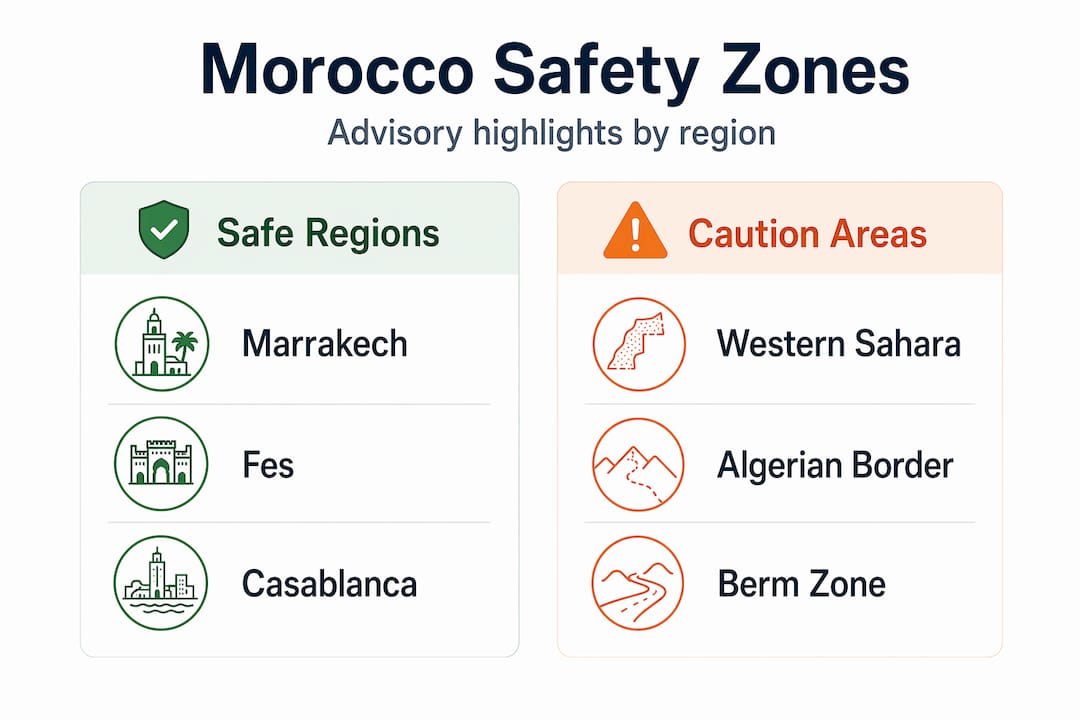
Terrorism remains a background concern across North Africa, and Morocco is no exception. The government maintains robust counterterrorism operations and has a strong record of disrupting plots. Petty crime in urban tourist areas, including pickpocketing, bag snatching, and scams, is a far more realistic concern for visitors than political violence.
Political protests occur periodically, particularly around Rabat and Casablanca, and can turn volatile near government buildings on Fridays and weekends. Avoid demonstrations entirely. That is not a dramatic precaution. It is standard practice in any country.
City and region safety at a glance
| City/Region | Safety Level | Main Concern |
|---|---|---|
| Marrakech | High tourism safety | Petty theft and scams in medina |
| Fes | High tourism safety | Fake guides, crowded lanes |
| Chefchaouen | Very relaxed | Minimal incidents |
| Rabat | Generally safe | Occasional protests nearby |
| Casablanca | Urban vigilance needed | Street theft in some neighborhoods |
| Western Sahara/Algerian border | Avoid | Political instability, landmine risk |
Pro Tip: Register your trip with your government’s traveler registration program before departure. It takes five minutes and means your embassy can reach you if a regional situation changes unexpectedly.
Local customs, laws, and cultural nuances
Morocco’s biggest safety risks for tourists tend to be logistical and cultural rather than violent. Understanding local customs is not just about being respectful. It directly shapes how safe and comfortable your experience will be.
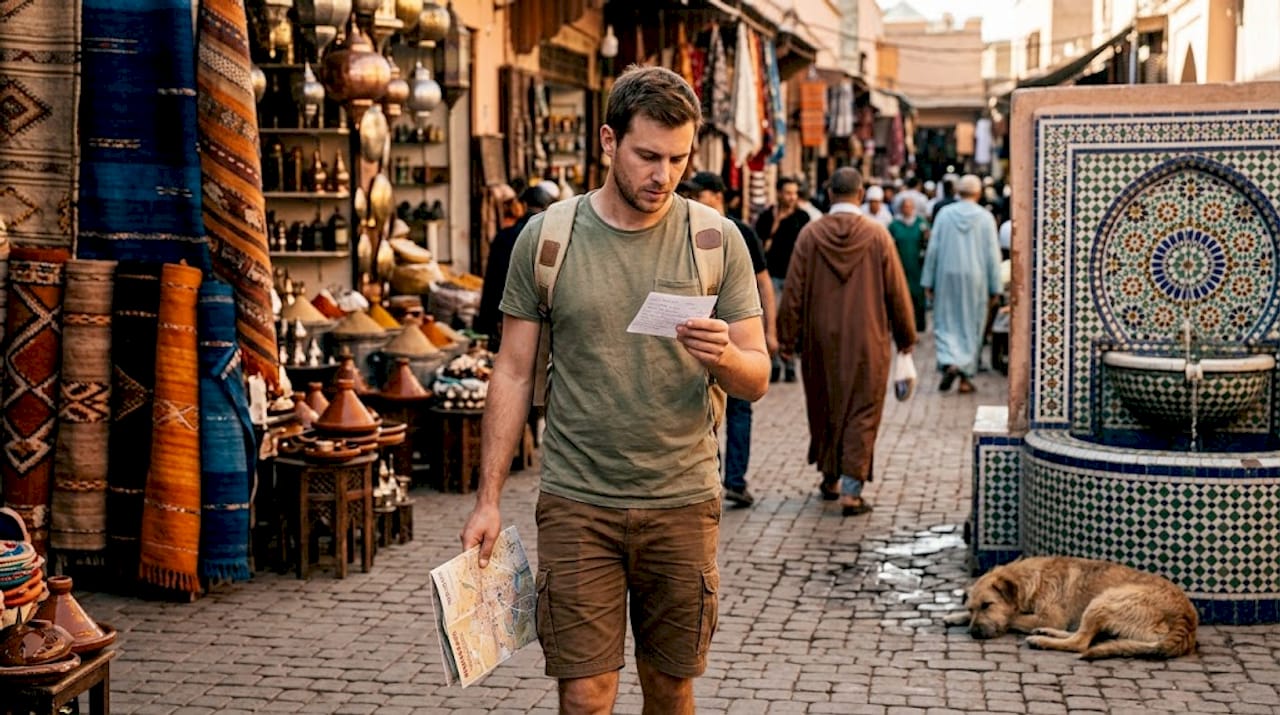
Dress is the most immediate consideration. Morocco is a predominantly Muslim country where conservative dress is the norm, especially outside of beach resorts. For all travelers, covering shoulders and knees in medinas, mosques, and rural areas reduces unwanted attention. For solo female travelers, modest clothing and a confident walking pace are among the most practical tools available. Morocco is not inherently unsafe for women traveling alone, but it does require more situational awareness than many Western destinations.
Several legal realities catch visitors off guard:
- Alcohol is available in licensed hotels, bars, and restaurants, but drinking in public spaces is illegal and disrespectful to locals.
- LGBTQ+ relationships are criminalized under Moroccan law. Same-sex couples should exercise considerable discretion in public.
- Photography of people without permission, particularly women and government buildings, can cause serious friction.
- Cannabis is technically illegal despite its visible presence in some northern regions. Do not assume tolerance equals legality.
Verbal harassment in the medinas of Marrakech and Fes is common and can feel overwhelming on your first day. Men and women on foot will be approached by people offering directions, tour services, and souvenirs. Physical danger is rare. The most effective response is a firm, calm “no thank you” and continued walking without making eye contact. Engaging, even to argue, signals you might be persuadable.
The guide situation deserves its own mention. Official guides wear government-issued ID badges and are licensed through the Ministry of Tourism. Unofficial guides, sometimes called “faux guides,” work on commission from shops and will steer you away from what you actually want to see. If you want to avoid this entirely, booking through a reputable operator like Topmoroccotravel connects you with licensed professionals who know the role of tour operators in protecting visitor experiences.
Pro Tip: Learn five words of Darija (Moroccan Arabic) before you arrive. “Shukran” (thank you) and “La, shukran” (no, thank you) will serve you in more situations than any app.
Health, environmental, and natural hazards
Health preparation is where many travelers underinvest. Morocco does not require vaccinations for entry, but that does not mean preparation is optional. Recommended vaccinations include Hepatitis A and B, Typhoid (especially if you plan to eat street food), a Tetanus booster, and Rabies if you are hiking, trekking, or spending time in rural areas where stray animals are common.
Water safety is straightforward but non-negotiable. Tap water is treated in Moroccan cities but commonly causes stomach trouble in travelers whose systems are not adapted to local microbes. Drink bottled or filtered water throughout your trip, including when brushing your teeth in budget accommodations.
Morocco’s climate creates its own category of risk:
- Summer heat in the Sahara and inland cities like Marrakech regularly exceeds 100°F (38°C). Heatstroke is a genuine threat if you are walking in medinas or desert areas without hydration planning.
- Flash floods occur in riverbeds (wadis) and mountain valleys, particularly in spring and fall. They move fast and with almost no warning. Do not camp in dry riverbeds.
- Sandstorms in desert regions reduce visibility to near zero and can strand vehicles. Check local forecasts before desert excursions.
Road and mountain travel
| Risk Type | Situation | Recommended Action |
|---|---|---|
| Highway driving | Generally modern and maintained | Follow speed limits and stay alert at night |
| Mountain roads | Narrow, unlit, steep | Avoid night driving; hire a local driver |
| Pedestrian crossings | Drivers rarely yield | Cross with caution at all times |
| Rural tracks | Unpaved, unmarked | Use 4WD vehicles with a guide |
Road safety is a real concern in Morocco. Aggressive driving practices and poorly lit rural roads contribute to a higher accident rate than many visitors anticipate. If your itinerary includes the Atlas Mountains or the Draa Valley, a pre-booked private transfer with an experienced local driver is worth every cent.
Emergency contacts to save before you travel: Morocco’s national emergency number is 15 (medical), 19 (police), and 177 (gendarmerie for rural areas). Private clinics in Marrakech and Casablanca provide good care. Public hospitals vary significantly in quality.
Practical safety tips for getting around
Getting from point A to point B safely in Morocco is mostly about making smart choices before you need to make them under pressure.
- Use trains for intercity travel. Morocco’s ONCF rail network connects Casablanca, Rabat, Fes, Tangier, and Marrakech reliably and safely. It is significantly safer than driving and cheaper than private transfers for solo travelers.
- Always negotiate taxi fares before getting in. Petit taxis (city taxis) do not always use meters. Agree on a price before the door closes or insist the meter runs. A fare that feels like a bargain at departure can double by the time you arrive if you did not set terms.
- Stick to official taxi ranks at night. After dark, avoid hailing cars from the street that are not clearly marked taxis. Book through your hotel or use a ride-hailing app like Careem, which is available in major cities.
- Split your cash. Keep a small amount in an accessible pocket for daily purchases and lock your passport, credit cards, and most of your cash in your accommodation’s safe. Muggings and bag snatching occur mostly in crowded areas, so carrying everything with you is the highest-risk behavior.
- Choose riads and hotels in well-lit, accessible neighborhoods. The romance of a deep-medina riad is real, but so is the disorientation of trying to find it at midnight in an unmarked alley. Know your route before nightfall, or ask your accommodation to send someone to meet you.
- Use Morocco’s tourist police. Tourist police (Brigade Touristique) are stationed in major tourist cities and are there specifically to assist visitors. If a tout is being aggressive or you feel a scam is unfolding, walking toward a uniformed officer resolves the situation quickly.
Pro Tip: Download offline maps of each city before you arrive. Getting lost in Fes’s medina is charming in the daytime with a charged phone. At night without data, it is a very different experience.
For more on how to move through Moroccan cities with confidence, the Moroccan city exploration tips resource from Topmoroccotravel is worth bookmarking before your trip. You can also find broader preparation advice in the full Morocco travel guide covering everything from packing to cultural etiquette.
My honest take on safety and Morocco
I’ve spent years helping travelers prepare for Morocco, and the pattern I see most often is this: the people who are most anxious before they go are the same people who come back and say it was the most welcoming place they have ever visited. Fear of Morocco is usually fear built from unfamiliarity, not from evidence.
Morocco has almost zero gun violence, and experts consistently note that it is safer than many major Western cities when it comes to violent crime. What Morocco does have is an intense, fast-moving sensory environment, particularly in the old medinas, where the combination of persistent touts, unfamiliar streets, and language barriers can feel chaotic. That is not danger. That is culture shock, and it passes within 24 to 48 hours for most visitors.
What I’ve learned from watching hundreds of travelers move through this country is that preparation is the antidote to anxiety. Knowing what to expect from a faux guide before one approaches you means you can respond calmly instead of panicking. Knowing that modest dress reduces friction means you make one simple wardrobe decision that pays off for the entire trip. Respecting local norms is not just good manners. It is the most practical “how to stay safe in Morocco” advice I can offer.
My honest recommendation: go. Go with your eyes open, with your government advisory read, with your vaccinations current, and with a reliable local operator in your corner for at least part of the journey. Morocco will meet you more than halfway.
— TopMoroccoTravel.com
Plan a safer trip with expert local guidance
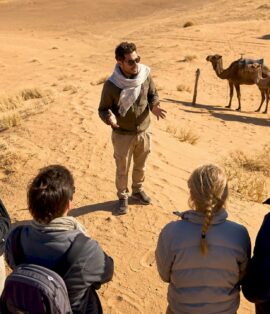
Knowing the facts about Morocco travel security advice is one thing. Having a trusted local partner to handle the logistics is something else entirely. Guided tours enhance safety by leveraging on-the-ground knowledge that no travel article can fully replicate. A licensed guide knows which streets are best avoided after dark, which riads are genuinely trustworthy, and how to read a situation before it becomes a problem.
At Topmoroccotravel, we design experiences around exactly this kind of preparation. Whether you are drawn to the imperial cities of Fes and Meknes, the art deco architecture of Casablanca, or the silence of the Sahara at dawn, our team builds itineraries that put you in remarkable places with the cultural context and local support to truly enjoy them. Our Moroccan city tour concepts pair luxury comfort with authentic access, and our guided desert adventures are operated by teams who know the terrain and the conditions intimately.
You can also explore the advantages of guided tours in detail before you decide. The bottom line is simple: traveling with expert local support turns Morocco travel safety tips from a checklist into lived practice. Reach out to our team and let’s build something worth remembering.
FAQ
Is Morocco safe to visit?
Yes. Major Western governments rate Morocco as Level 1 or Level 2 for travel, indicating normal to increased caution rather than high risk. Tourist cities like Marrakech, Fes, and Chefchaouen have strong security infrastructure and low violent crime rates.
What are the biggest safety risks for tourists in Morocco?
Petty crime, including pickpocketing and scams, is the most common concern for visitors, particularly in crowded medinas and tourist markets. Physical violence against tourists is rare, and most incidents are preventable with standard situational awareness.
Is Morocco safe for solo female travelers?
Solo female travelers can visit Morocco safely with preparation. Modest dress, confident body language, and avoiding isolated areas at night significantly reduce unwanted attention. More preparation is needed compared to many Western destinations, but the experience is rewarding and manageable.
What health precautions should I take before traveling to Morocco?
Get vaccinated for Hepatitis A and B, typhoid, and Tetanus before your trip. Drink bottled water throughout your stay, as tap water commonly causes stomach issues for travelers even when technically treated.
Are there areas of Morocco I should avoid?
Yes. The Western Sahara berm region and areas near the Algerian border carry elevated risks and are flagged by multiple government advisories. All mainstream tourist destinations, including the imperial cities, coastal towns, and established desert routes, are considered safe for visitors.


Comments are closed