




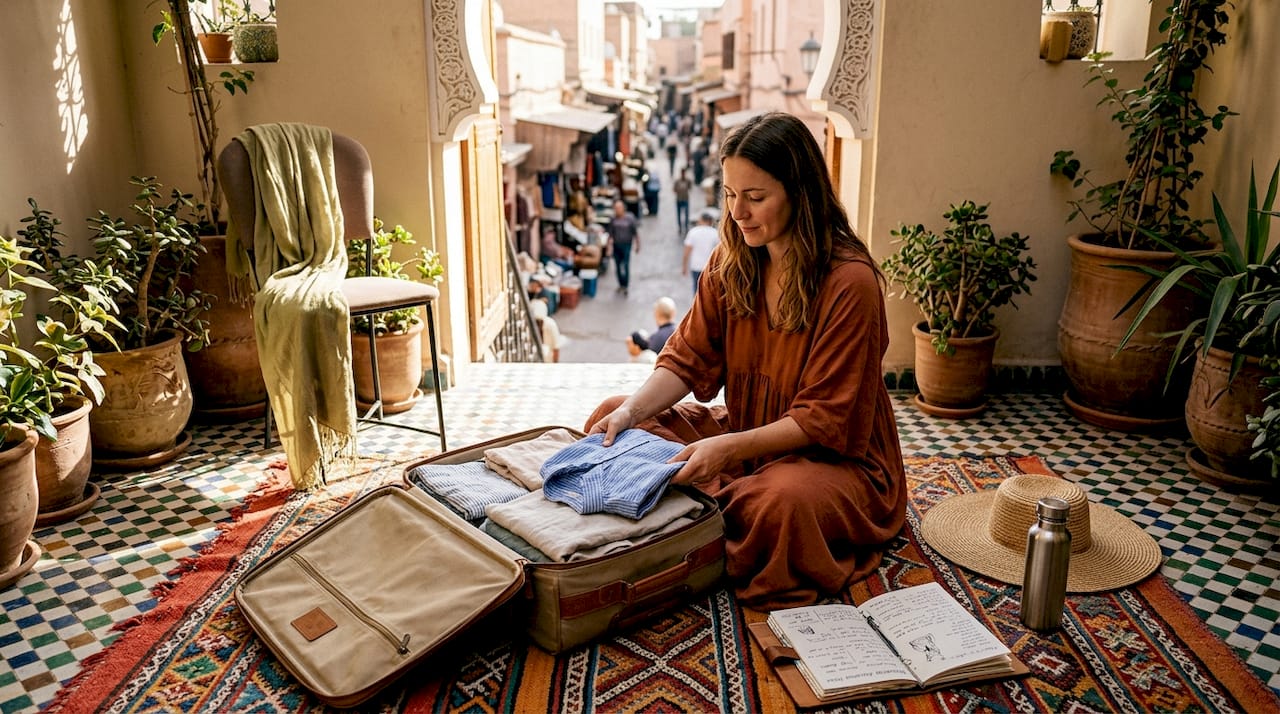
- Travelers should dress modestly by covering shoulders and knees in Morocco’s cultural contexts, especially in rural areas and religious sites.
- Layering lightweight fabrics like cotton and linen ensures comfort across Morocco’s diverse climates, from coastal breezes to desert heat.
- Practical footwear includes closed-toe shoes with grip for city streets and sandals for leisure, with scarves serving multiple functional purposes throughout the trip.
Planning your wardrobe for Morocco trips leaves most travelers second-guessing themselves, and honestly, the mixed advice online makes it worse. Knowing what to wear in Morocco comes down to two equally important factors: the country’s dramatic climate variation and its deep cultural norms around modesty. Get both right, and you move through medinas, desert dunes, mountain villages, and coastal resorts with confidence and zero stress. Get it wrong and you attract unwanted attention or spend half your trip uncomfortably overdressed or underdressed. This guide cuts through the confusion with specific, situation-by-situation clothing advice that actually works.
Table of Contents
- Key Takeaways
- What to Wear in Morocco: Climate and Culture First
- Practical clothing tips by gender and activity
- Seasonal packing guide for Morocco
- Dressing respectfully without overdoing it
- My honest take on dressing for Morocco
- Plan your Morocco trip with confidence
- FAQ
Key Takeaways
| Point | Details |
|---|---|
| Modesty is the baseline | Keep shoulders and knees covered in public spaces to avoid unwanted attention and show respect. |
| Layers solve everything | Temperature swings between day and night, coast and desert, are significant. Pack layers over single heavy items. |
| Fabric choice is critical | Lightweight cotton and linen handle Morocco’s heat far better than synthetic fabrics. |
| Footwear matters more than you think | Medina streets are uneven and rough. Closed-toe shoes with grip are a non-negotiable for city exploration. |
| One scarf, many purposes | A large scarf works as sun protection, wind block, modest cover, and beach wrap all in one piece. |
What to Wear in Morocco: Climate and Culture First
Before you start pulling clothes off hangers, you need to understand what you are actually packing for. Morocco is not one climate. It is four.
The Atlantic coast cities like Casablanca and Essaouira stay mild and breezy year-round, rarely exceeding 85°F in summer. Marrakech and the interior cities bake in summer, hitting 104°F regularly between June and August but dropping to near-freezing on winter nights. The Sahara Desert swings between scorching midday heat and surprisingly cold nights, sometimes with a 50-degree temperature difference in a single day. The Atlas Mountains can see snow well into spring.
Then there is the cultural context. Morocco has no official clothing restrictions for tourists, but cultural norms around modesty are strong and very real, particularly in rural areas, religious sites, and older medinas. These are not laws. They are social expectations, and ignoring them in the wrong setting creates friction that no traveler wants.
Urban versus rural expectations
Moroccan cities exist on a spectrum. Casablanca and Tangier are cosmopolitan. You will see local women in jeans and sleeveless tops. Marrakech is more conservative, especially in the medina and souks. Rural villages and Sahara communities are the most traditional, where revealing clothing attracts unwanted attention and can affect how locals interact with you. Beachwear stays at the beach or pool. That is the line.
Here is a quick breakdown of what to expect by location:
- Coastal cities (Casablanca, Agadir beach zones): More relaxed, but modesty still appreciated away from resort areas
- Imperial cities (Fez, Meknes, and Marrakech medina): Conservative. Cover shoulders and knees without exception
- Rural villages and Atlas Mountain communities: Most traditional. Long sleeves and pants or long skirts are standard
- Sahara Desert camps: Modest but practical. Wind and sand drive clothing choices as much as culture
- Tourist beach resorts: Swimwear acceptable in designated areas only
The practical solution to all of this is one word: layering. Breathable fabrics like cotton and linen give you coverage without trapping heat. A loose linen shirt over a tank top lets you adapt instantly depending on where you are standing.
| Climate Zone | Typical Temperature Range | Key Clothing Need |
|---|---|---|
| Atlantic Coast | 60°F to 85°F | Light layers, wind protection |
| Marrakech and interior | 50°F to 104°F | Breathable coverage, sun protection |
| Sahara Desert | 40°F to 110°F | Extreme layering, sand protection |
| Atlas Mountains | 25°F to 75°F | Thermal layers, waterproof shell |
Practical clothing tips by gender and activity
Now for the specifics. The right Morocco travel outfits follow a simple logic: loose, breathable, and covering the right parts of your body.
For women
The safe and respected outfit formula for women covers shoulders and knees with a loose fit. This is not a rigid rule so much as the starting point that removes almost every potential issue. From there, you build around comfort and heat.
Flowy pants and maxi dresses are the gold standard. They allow airflow, meet modesty expectations, look put together, and handle both medina walks and riad dinners. Wide-leg linen pants paired with a loose cotton blouse is a near-perfect combination for summer days in Marrakech.
Specific pieces that work well:
- Maxi dresses or midi skirts (above the knee is fine in resorts but draws looks in medinas)
- Loose linen or cotton shirts with at least cap sleeves, ideally covering the shoulder
- Wide-leg or straight-cut pants in breathable fabrics
- A lightweight cardigan or linen layer for covering up quickly
- A large scarf or pashmina (more on this below)
For mosque visits like the Hassan II Mosque in Casablanca, requirements become strict: ankle-length coverage, shoulders and arms fully covered, and a headscarf. Keep a scarf in your bag at all times.
For men
Men have it slightly easier in Morocco, but the common assumption that shorts and t-shirts are fine everywhere is simply wrong. Long pants are the right call in medinas, religious sites, and rural areas. Chinos, linen trousers, or lightweight travel pants all work well. A short-sleeve linen or cotton shirt is perfectly acceptable in cities. Men visiting the Hassan II Mosque need long trousers and sleeves.
Shorts are acceptable at beach resorts and on desert camps after you have cleared the main town areas. In the medina of Fez? Put them away. You will not be turned back at the gate, but you will stand out in a way that changes how vendors and locals interact with you.
Footwear for Morocco
This deserves its own conversation because it catches more travelers off guard than almost anything else. Closed-toe shoes are strongly recommended for medinas due to uneven, dusty, and sometimes muddy streets.
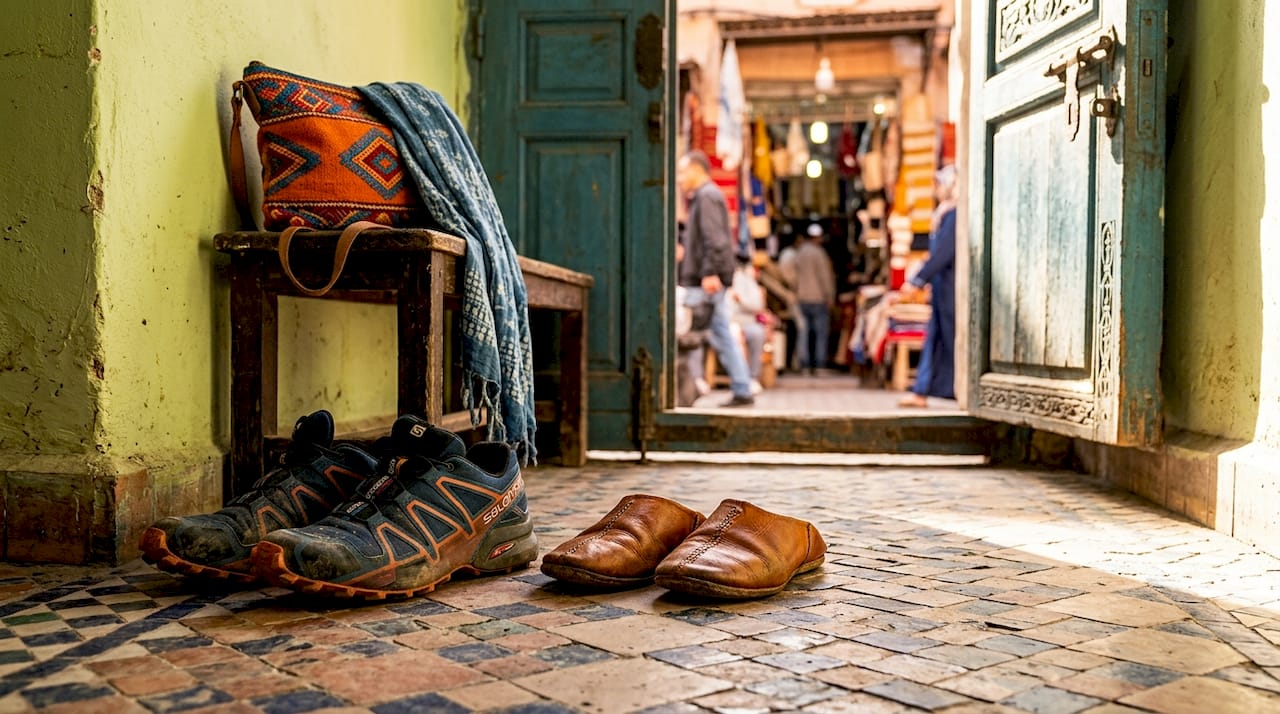
Lightweight trail runners or hiking shoes with good ankle support and grip are the practical best choice. Break them in before you travel. Blisters in the medina of Fez are a special kind of miserable. Sandals are fine for riads, beach days, and evening meals. Flip flops stay in your bag except at the pool.
Pro Tip: Pack a pair of slip-on shoes or sandals for riad stays and mosque visits where you will be removing shoes frequently. It saves time and keeps things simple.
Desert and outdoor activities
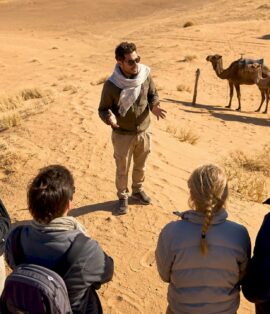
The Sahara requires its own clothing logic. Daytime heat demands the same light coverage as the cities, but desert nights get genuinely cold. Thermal base layers and a fleece or light down jacket are not optional if you are doing an overnight at a desert camp. Scarves serve a vital practical function in the desert as protection against sand and wind, not just sun. Wrap one around your face during sandstorms and you will be grateful you had it.
Seasonal packing guide for Morocco
What you pack depends heavily on when you visit. Morocco’s seasons create genuinely different clothing challenges.
Summer (June through August) is intense. Marrakech and Fez regularly exceed 100°F. Your entire focus is on staying cool while remaining covered.
- Bring two to three maxi dresses or wide-leg linen pants as your core pieces
- Pack thin cotton or linen shirts in light colors, which reflect heat better than dark ones
- Include a wide-brim hat and UV-protective sunglasses
- Bring a small, lightweight daypack so your hands stay free while carrying a scarf and layer
- Pack high-SPF sunscreen because the sun at altitude and in open desert is brutal
Winter (December through February) surprises most visitors. Moroccan homes and riads lack central heating, and evenings in Fez and Marrakech regularly drop below 45°F. You need more warm layers than you expect.
- Thermal base layers are worth their weight for early mornings and cold rides
- A waterproof outer shell jacket is necessary if visiting Atlas Mountain areas
- Bring a mid-weight sweater or fleece for evening meals
- Wool socks make a real difference at altitude
Spring (March through May) and fall (September through November) are the easiest seasons to pack for. Temperatures are pleasant, ranging from the mid-60s to low 80s most days.
| Season | Must-Pack Item | What to Leave Home |
|---|---|---|
| Summer | Wide-brim hat, linen layers | Jeans, heavy fabrics, dark colors |
| Winter | Thermal base layers, fleece | Sundresses without layering options |
| Spring/Fall | Light cardigan, versatile scarf | Heavy coats, bulky sweaters |
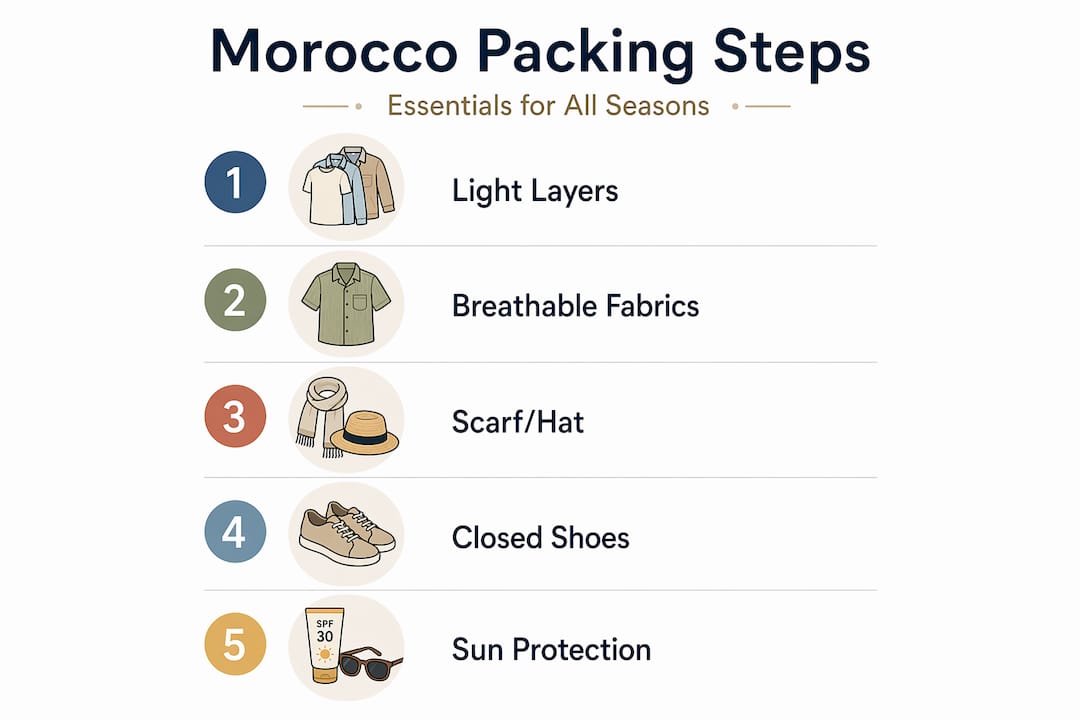
Pro Tip: Buy a lightweight cotton scarf or Moroccan cloth in the souks when you arrive. They cost almost nothing, are better quality than most travel stores sell, and serve every purpose from sun cover to prayer site requirement to souvenir.
Dressing respectfully without overdoing it
There is a tendency among well-meaning travelers to overcompensate when it comes to dressing modestly in Morocco. They arrive wearing head-to-toe black covering in 100-degree heat and end up miserable. Respect for local norms does not require performing local dress. It requires knowing where your choices land on the spectrum.
The practical rules are straightforward:
- Cover your shoulders and knees in medinas, markets, mosques, and rural areas
- Avoid clothing with very tight fits in public spaces, even if fully covered
- Beach and resort wear stays at the beach and resort
- Remove footwear when entering mosques and when asked at any traditional home
Dressing modestly genuinely reduces traveler hassle and opens doors to warmer interactions. When locals see you making an effort, even a small one, the social temperature shifts. You get better directions, friendlier conversations, and fewer hustlers trying to attach themselves to your day.
The common mistakes worth avoiding are wearing sleeveless tops or short shorts in the medina, carrying a shawl but not using it when the situation calls for it, and wearing overly casual beachwear through market areas. None of these will get you arrested. All of them will make your experience worse.
“The goal isn’t to dress like a local. It’s to dress in a way that says you understand where you are.” This is the mindset that makes every interaction in Morocco easier.
Layers and a well-chosen scarf solve almost every situation you will encounter. Throw on a loose shirt over your tank top before entering the medina. Drape your scarf when you step into a mosque courtyard. The adjustments take ten seconds, and the return is substantial.
My honest take on dressing for Morocco
I have worked with hundreds of travelers preparing for Morocco trips, and the anxiety around clothing is almost always disproportionate to the reality on the ground. People arrive expecting a rigid dress code enforced at every corner. What they find is a country where a little common sense and a genuine willingness to adapt get you further than any specific outfit formula.
What I have learned is that the travelers who struggle most are those who pack for two extremes. They either bring only tight Western resort wear and feel uncomfortable every time they leave the pool, or they pack such conservative clothing that they are sweating through Marrakech in July wearing long sleeves they genuinely did not need.
The truth is somewhere practical in between. Loose, breathable coverage is not a sacrifice. In 100-degree heat, a flowing linen shirt is actually more comfortable than a fitted sleeveless top, because it blocks the sun without trapping body heat. The cultural and the practical align more often than people expect.
My personal recommendation is to explore Morocco’s imperial cities and desert regions as a connected experience rather than treating them separately. Your wardrobe for both is nearly identical: light layers, a great scarf, and shoes that can walk five miles on uneven stone. When you think of your Morocco wardrobe as one adaptable system rather than separate outfits for separate places, packing becomes much simpler, and the trip itself opens up.
— TopMoroccoTravel
Plan your Morocco trip with confidence
Knowing what to pack is the first step. Knowing where to go and what to do when you get there is where the real trip begins. At TopMoroccoTravel, we design experiences that take the guesswork out of every part of your Morocco journey, including guidance on how to dress and move through each region with ease and cultural confidence.
Whether you are drawn to the ancient medinas of Fez and Marrakech, the silence of a Sahara Desert camp, or the craftsmanship of the imperial cities, our tailored Morocco tours are built around your pace, your interests, and the kind of authentic experiences that make Morocco unforgettable. Our team handles the logistics so you can focus on showing up prepared and genuinely present for what Morocco offers.
Explore our Morocco travel packages and let us help you build the trip that fits.
FAQ
What is the dress code for tourists in Morocco?
Morocco has no official clothing laws for tourists, but cultural norms strongly recommend covering shoulders and knees in public spaces, especially in medinas, markets, and religious sites. Beachwear is acceptable only at beaches and pools.
What should women wear in the medina?
Women should wear loose-fitting clothing that covers shoulders and knees. Maxi dresses, wide-leg pants, and linen shirts are practical and well-received choices that handle both heat and cultural expectations.
Do I need a headscarf in Morocco?
A headscarf is only required for entering mosques open to tourists, such as the Hassan II Mosque, where women must cover their hair completely. Outside of religious sites, it is optional, but carrying a scarf is useful for multiple practical purposes.
What fabrics work best in Moroccan heat?
Lightweight cotton and linen are the best choices for Morocco’s hot weather. They breathe well, dry quickly, and provide the loose coverage that works in both cultural and climate terms.
What shoes should I bring to Morocco?
Bring closed-toe shoes with good grip for medina walking, plus sandals for riads and evenings. Trail runners or lightweight hiking shoes are ideal since Medina streets are uneven and can be slippery.


Comments are closed