




TL;DR:
- Ouzoud Falls in Morocco, the tallest in the country, features dramatic three-tiered cascades attracting visitors for hiking, boat rides, and wildlife encounters.
- Best visited in spring for lush scenery and rainbows, the site offers accessible local guides, outdoor activities, and options for day trips or overnight stays.
- Planning ahead ensures a full experience, with organized tours supporting local communities and enriching your visit.
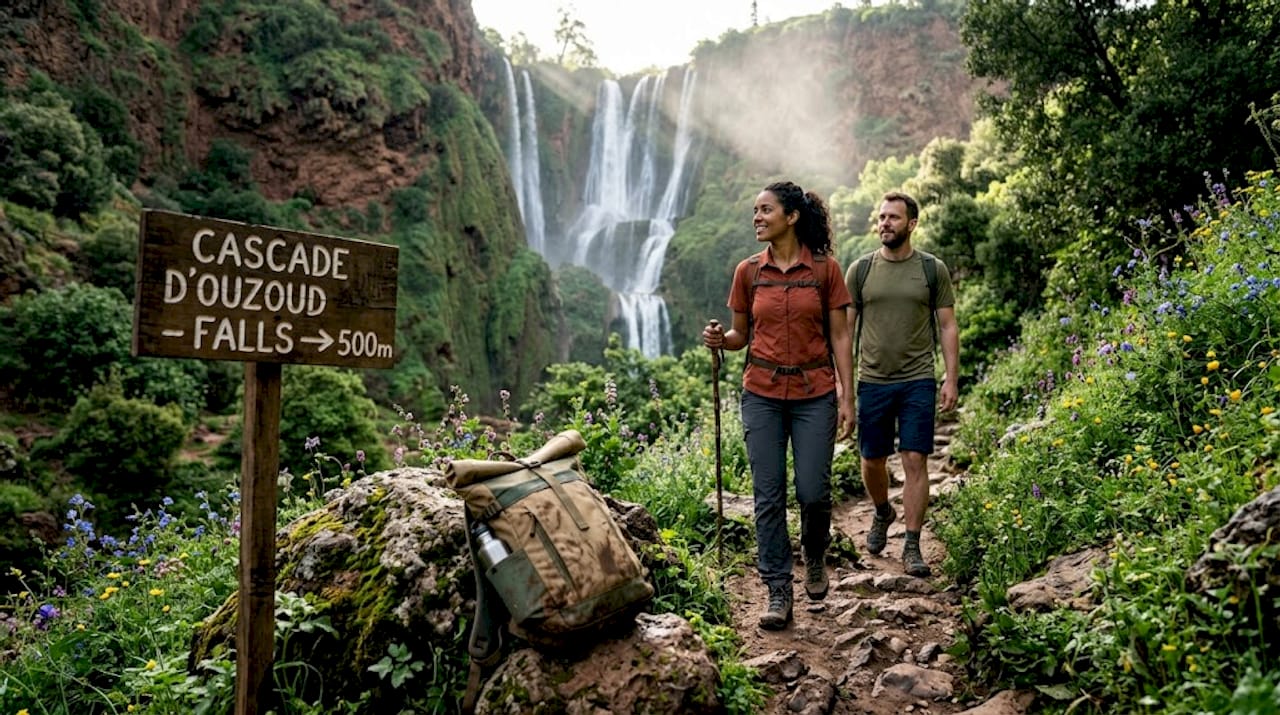
Few natural attractions in Africa stop people the way Ouzoud does. The Morocco waterfalls, Ouzoud, sit at 110 meters tall, making them the tallest in Morocco and among the most spectacular in all of North Africa. They sit about 150 km from Marrakech, close enough for a day trip but dramatic enough to earn an overnight stay. Wild Barbary macaques roam the cliffs, rainbows form in the mist by mid-morning, and local Berber families have farmed the surrounding olive groves for generations. This guide gives you everything you need to plan a visit that goes well beyond a quick photo stop.
Table of Contents
- Key takeaways
- What makes Ouzoud waterfalls unique
- How to reach Ouzoud Falls from Marrakech
- Top activities at Ouzoud Falls
- Best time to visit and practical tips
- Planning your stay and choosing a tour
- My honest take on Ouzoud after years of Morocco visits
- Plan your Ouzoud trip with Topmoroccotravel
- FAQ
Key takeaways
| Point | Details |
|---|---|
| Morocco’s tallest waterfall | Ouzoud drops 110 meters and requires no entrance fee, making it accessible to all budgets. |
| The best season is spring | March through May delivers peak water flow, lush scenery, and the most vivid rainbows. |
| Multiple ways to get there | Private car, organized tours, and grand taxis all work; organized tours offer the most convenience. |
| Activities go beyond sightseeing | Boat rides, hiking, wildlife encounters, and Berber dining create a full-day experience. |
| Arriving early matters | Reaching the falls before 9 a.m. avoids crowds and gives you the best photography light. |
What makes Ouzoud waterfalls unique
Ouzoud sits inside the Middle Atlas Mountains in Azilal Province, roughly halfway between Marrakech and the Saharan edge of Morocco. The falls themselves cascade in three distinct tiers, each one dropping over red and orange rock faces worn smooth by centuries of erosion from the El Abid River. That erosion process created a wide canyon below the falls, lined with fig trees, oleander, and groves of wild olive trees that give the site its name. The word “Ouzoud” comes directly from the Berber word for “olive,” and those trees are everywhere. Interestingly, the local olives are so small that they are pressed for oil rather than eaten, a detail that says a lot about how deeply agricultural traditions shape the area.
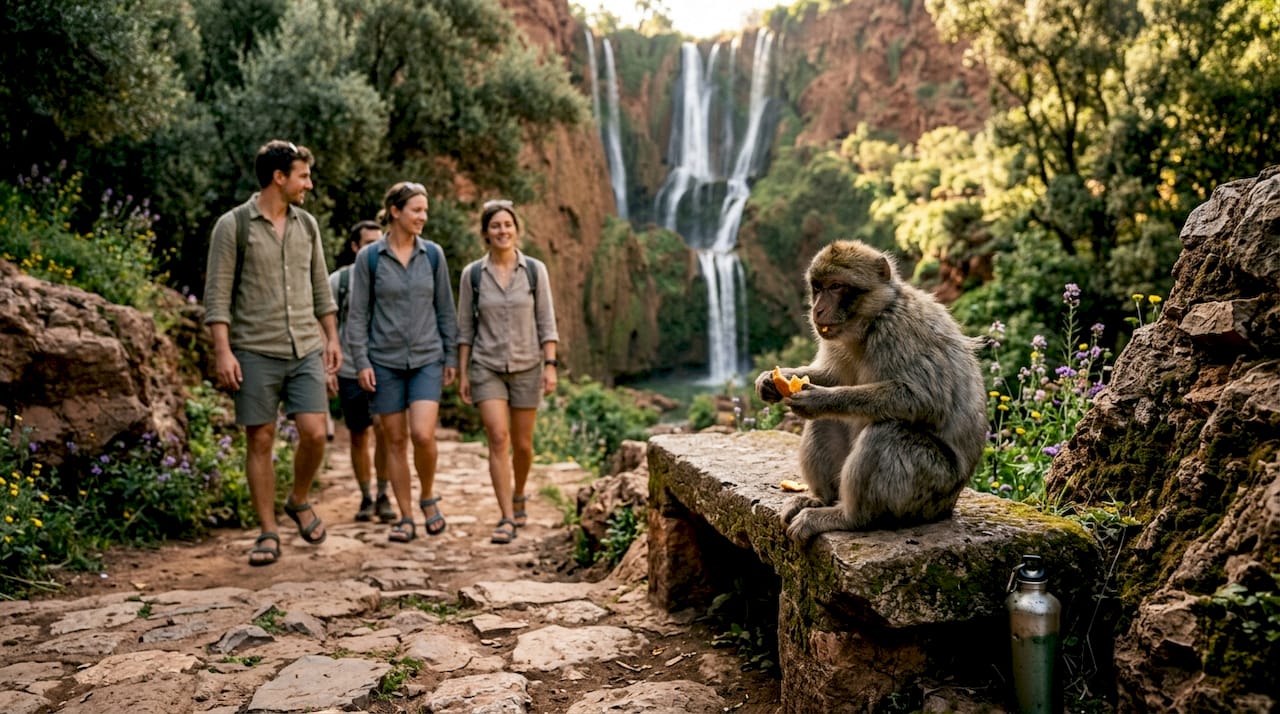
The ecosystem around the falls is what separates Ouzoud from most Moroccan natural attractions. Wild Barbary macaques live in the canyon walls and olive trees, and they are completely habituated to visitors. You will see them swinging through branches above the trails, crossing paths with hikers, and occasionally descending to the lower viewpoints. This is the last place in Morocco where you can reliably see this endangered primate species in a completely wild setting.
The three-tiered waterfall structure creates several distinct viewing levels, each with its own perspective on the falls. From the top, you look out over the canyon and the green hills beyond. From the base, the falls fill your entire field of vision, and the sound is thunderous. That vertical range is what makes Ouzoud feel so physically immersive compared to most waterfalls you will find anywhere in the region.
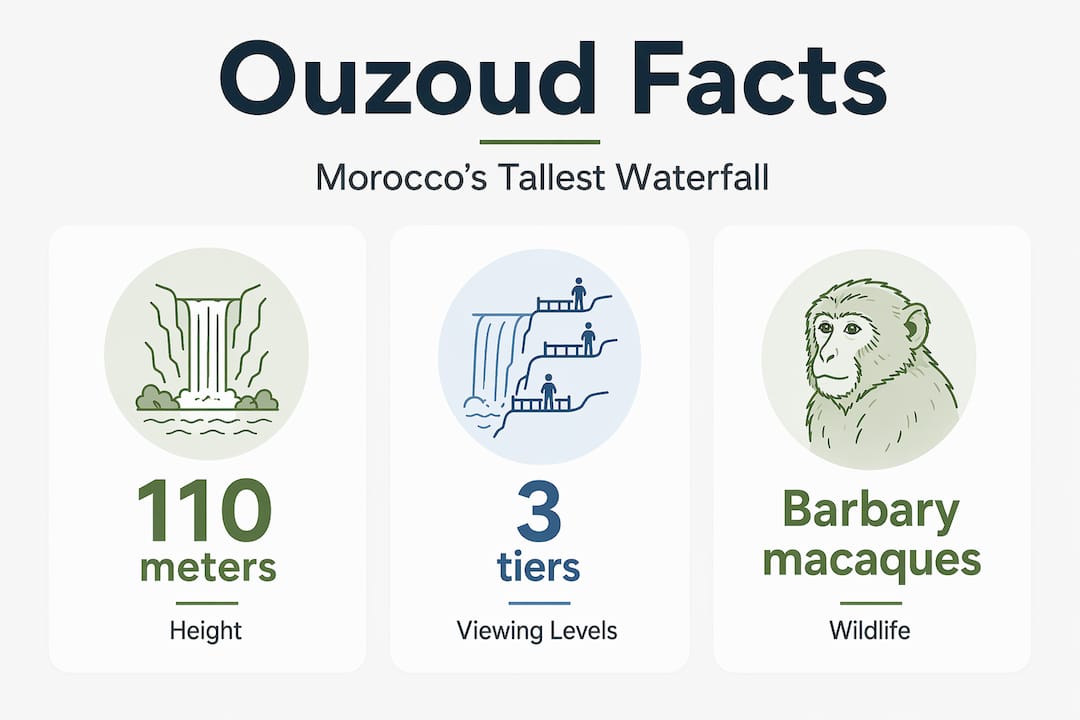
Quick facts about Ouzoud
| Feature | Details |
|---|---|
| Height | 110 meters (330 feet) |
| Location | Azilal Province, Middle Atlas Mountains |
| River source | El Abid River |
| Entrance fee | Free |
| Wildlife | Barbary macaques, kingfishers, herons |
| Name origin | Berber for “olive” |
How to reach Ouzoud Falls from Marrakech
The typical drive takes about 2.5 hours from Marrakech, covering roughly 150 km on roads that wind through small Berber villages and mountain foothills. The route is scenic once you leave the city, but navigation requires either a GPS or a pre-downloaded map since signage is inconsistent in rural areas. Here are your four main transport options:
- Private car rental: Most flexible option. You control your schedule, can stop for photos along the route, and leave on your own timeline. Requires confidence driving on Moroccan rural roads, which can be narrow in sections.
- Organized day tour: The most popular choice for first-time visitors. Tours typically include hotel pickup, a guide, lunch, and boat rides, which means you arrive knowing exactly what to expect. Cost generally ranges from $30 to $60 per person depending on the operator and inclusions.
- Grand taxi: Shared long-distance taxis run from Marrakech’s Bab Doukkala station toward Azilal, with a connection to Ouzoud village. This takes significantly longer, involves at least one transfer, and is not comfortable for long stretches. Budget travelers use it successfully.
- Public bus: Buses serve Azilal, but the final leg to the falls requires a separate taxi. This is the most time-consuming option and works best only if you are already spending the night in the area.
Pro Tip: If you are traveling as a group of four or more, hiring a private driver for the day often costs less per person than an organized tour while still giving you local insight and door-to-door service. Ask your accommodation to recommend a vetted driver rather than booking through the medina.
Understanding why guided tours outperform self-navigation in Morocco comes down to one factor: local knowledge. A guide who visits Ouzoud regularly will know exactly where the monkeys gather in the morning, which trail section becomes slippery after rain, and which Berber restaurant serves food that locals actually eat.
Top activities at Ouzoud Falls
Ouzoud rewards visitors who spend more than two hours there. The site has enough to fill a full day if you engage with it properly rather than just walking to the main viewpoint and leaving. Here is how to approach your time:
- Hike the canyon trail. The main Ouzoud Falls hike starts from the village and descends through olive groves to the river base. The descent takes about 20 to 30 minutes at a relaxed pace. A secondary upper trail leads to a less-visited viewpoint above the falls where the canyon spreads out below you. This upper spot is where serious photographers set up before the crowds arrive.
- Take a boat ride. Wooden boats rowed by local operators take visitors directly under the falls for a close-up view. The experience costs $5 to $10 per person and lasts about 15 minutes. You will get wet. Genuinely soaked, in fact. The spray from 110 meters of falling water is not gentle, but the view looking straight up at the tiered cascade from water level is something you cannot get from any trail.
- Spot the Barbary macaques. These primates move in troops along the canyon and show up near the main trail with regularity. Watch rather than interact. Do not offer them food, especially packaged snacks, since processed food damages their digestive systems and encourages aggressive behavior toward other visitors.
- Eat at a Berber terrace restaurant. Several small restaurants cling to the canyon walls above the falls, serving tagine, couscous, and mint tea with a direct view of the cascade. Eating here feels genuinely local because most of these spots are family-run operations that have served the same recipes for decades.
- Swim in the natural pools. From late May through September, the water at the base is warm enough for swimming. The natural pools form in the riverbed below the main falls, and the setting is extraordinary. Summer weekends draw Moroccan families here, which gives the spot a festive, communal atmosphere.
- Find the bridge viewpoint. A small bridge downstream offers one of the cleanest photography angles of the full waterfall face, particularly in morning light when the rainbow appears in the mist. This is also where a cliff-jumping scene has developed, with local young men launching from the rock face into the pools below.
Pro Tip: For the best light and the fewest people, arrive at the top of the trail by 8 a.m. The rainbow at the base forms between roughly 9 a.m. and 11 a.m. when the sun hits the mist at the right angle. Spring meltwaters produce the most intense rainbow effect, which is why May visits tend to generate the strongest photography results.
Best time to visit and practical tips
Timing shapes the entire Ouzoud experience. Get it right and you see a thundering cascade surrounded by green hills with rainbows forming constantly in the mist. Get it wrong and you are hiking down a steep path in 95-degree heat while the falls run at half capacity.
The best season runs from March through May. Snowmelt from the Atlas peaks feeds the El Abid River during this period, and the surrounding vegetation is at its greenest. Temperatures stay comfortable for hiking, typically between 65°F and 80°F, and the crowds are manageable on weekdays.
Summer visits (June through August) work well if swimming is your priority, but midday heat on the climb back up is punishing. The falls run lower in August, and the approach from the village can feel brutal in direct sun. If you visit in summer, be at the base before 10 a.m.
Winter brings cooler air, thinner crowds, and a moody mist that photographers love. The falls run well in December and January after autumn rains. Temperatures at the base can drop sharply, so layers are non-negotiable.
Here is what to pack and prepare regardless of season:
- Footwear: Sturdy closed shoes or hiking boots. The trail is uneven, and the climb back up is steep enough that flip flops become a genuine hazard.
- Cash in dirhams: Entrance to the falls is free, but boat rides, parking, and tips for informal guides require small bills. There is no ATM at the site.
- Waterproof layer or dry bag: If you take a boat ride, your phone and camera will get sprayed. Pack accordingly.
- Water and snacks: Restaurants are available, but having your own water for the trail keeps you comfortable between stops.
- Sun protection: The canyon reflects light intensely. A hat and sunscreen matter from April onward.
Pro Tip: Visiting Ouzoud with family works especially well when you time it for spring on a weekday. Kids love the monkey sightings and the boat ride, and the path down is manageable for children who are comfortable on uneven ground. Avoid school holiday weeks in Morocco (mid-February and July) if you want a quieter experience.
Planning your stay and choosing a tour
The majority of visitors treat Ouzoud as a day trip from Marrakech, but an overnight stay changes the experience significantly. Once the day-trippers leave in the late afternoon, the village settles into a quiet that feels completely different from the midday rush. Several guesthouses in the village offer rooms with terrace views overlooking the falls, and waking up to the sound of the cascade before the crowds arrive is genuinely worth the extra night.
Here is how to decide on your approach:
- Day trip with an organized tour: Best for first-time visitors to Morocco, solo travelers, and anyone who wants a structured, stress-free experience. Organized tours typically include transport, a local guide, lunch, and boat rides, so your total cost is predictable and covered upfront. Look at the best excursions from Marrakech to compare options and see what fits your itinerary.
- Day trip with private transport: Ideal for small groups or couples who want flexibility. You can pair Ouzoud with a stop in a Berber village along the route without sticking to anyone else’s schedule.
- Overnight stay: Worth it if you are combining Ouzoud with a drive deeper into the Middle Atlas. The area around Azilal has additional gorges, traditional souks, and rural landscapes that reward an extended trip.
When choosing a guide, the role of guides in Morocco tours goes well beyond navigation. A good local guide at Ouzoud explains the geological history of the canyon, introduces you to the Berber families who run the riverside restaurants, and takes you to viewpoints that do not appear on any tourist map. That context transforms a waterfall visit into something that stays with you.
Choosing an organized tour also supports the local economy in a direct way. The boat operators, restaurant owners, and informal trail guides at Ouzoud are almost entirely from the surrounding villages. When you book through a reputable operator rather than a cut-rate option that buses in tourists and rushes them out, more of that economic benefit stays local.
My honest take on Ouzoud after years of Morocco visits
I’ve taken dozens of travelers to Ouzoud over the years, and I consistently see the same mistake: people underestimate how much is actually here and rush it. They arrive late, skip the upper trail, eat a quick snack, take a boat ride, and leave before the afternoon light does something remarkable to the canyon walls.
The falls are genuinely extraordinary. But what makes Ouzoud stay with people is the combination of things you do not expect. The macaques appearing at eye level while you eat tagine on a terrace. The boat operator who rows you directly into the spray while grinning like this is still the best job in Morocco. The discovery that the canyon is not just a waterfall but an entire micro-ecosystem with its own sounds, smells, and rhythms.
My experience has consistently shown that visitors who give Ouzoud a full day, and especially those who arrive with a local guide, leave with stories rather than just photos. The practical stuff matters too. I’ve watched people attempt that return climb in sandals in August heat, and it is not a fun afternoon. Prepare for it like a hike, not a stroll.
What I’ve learned is that Morocco outdoor adventures hit differently when you stop treating them as checkboxes. Ouzoud is not a stop on the way to somewhere else. It is a destination that earns your full attention, and it rewards that attention generously.
— Topmoroccotravel
Plan your Ouzoud trip with Topmoroccotravel
Topmoroccotravel specializes in building Morocco experiences that go deeper than the standard tourist circuit. Whether you want a fully planned Ouzoud waterfalls tour with hotel pickup, local guide, and all logistics handled, or a custom Morocco travel itinerary that weaves Ouzoud into a longer Atlas and desert adventure, the team knows this region in detail. Every tour is built around authentic access, local operators, and the kind of pacing that lets you actually experience a place. Reach out through the website for personalized recommendations, or explore the tour packages to find the option that fits your travel style and budget.
FAQ
How tall are the Ouzoud Falls?
The Ouzoud Falls drop 110 meters, making them the tallest waterfall in Morocco and among the tallest in North Africa. Admission is free.
What is the best time to visit Ouzoud Waterfalls?
Spring, specifically March through May, delivers the best combination of peak water flow, green scenery, and comfortable hiking temperatures, with vivid rainbows forming in the mist most mornings.
How do you get to Ouzoud from Marrakech?
Ouzoud is roughly 150 km from Marrakech, about a 2.5-hour drive. Options include private car, organized day tours, and grand taxis, with organized tours offering the most convenient experience for most visitors.
Are boat rides worth it at Ouzoud?
Yes. Boat rides cost $5 to $10 per person and take you directly under the falls on simple wooden rafts rowed by local operators. The close-up view from water level is unlike anything you get from the trails.
Is Ouzoud suitable for families with children?
Visiting Ouzoud with family works well for children comfortable on uneven terrain. The monkey sightings, boat rides, and swimming pools in summer make it engaging for kids, and spring weekdays offer a calmer experience than summer weekends.




Comments are closed