




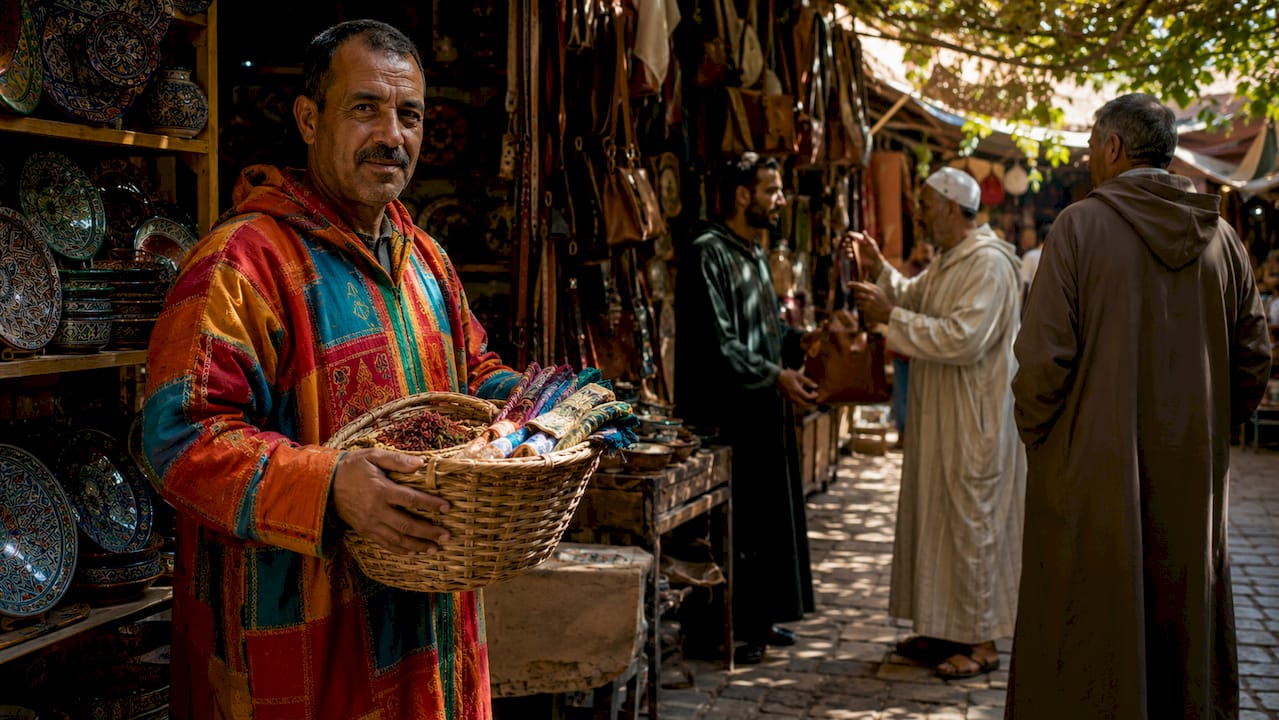
- Fez’s medina, a UNESCO World Heritage site, offers an authentic experience with active artisans and medieval architecture.
- Visitors should focus on key clusters like Bab Boujloud, tanneries, and madrasas, planning visits during optimal times such as mornings.
- Engaging in cultural workshops and slowing down enhances the city’s rich traditions beyond conventional sightseeing.
Fez is defined by its UNESCO-listed medina, the largest car-free urban zone in the world and the most concentrated collection of medieval Islamic architecture still in active daily use. The things to do in Fez range from standing at the iconic Bab Boujloud gate to watching leather dyers work stone vats at Chouara Tanneries exactly as they did eight centuries ago. This guide covers the top attractions in Fez, the cultural experiences worth your time, and the practical navigation strategies that separate a frustrating visit from a genuinely memorable one. Fez rewards travelers who slow down and engage directly with its layers.
What are the top must-see attractions in Fez’s medina?
The medina of Fez el-Bali is the oldest continuously inhabited medieval city in the world, and its landmarks are not museum pieces. They are living institutions. Start here before anywhere else.
Bab Boujloud (Blue Gate)
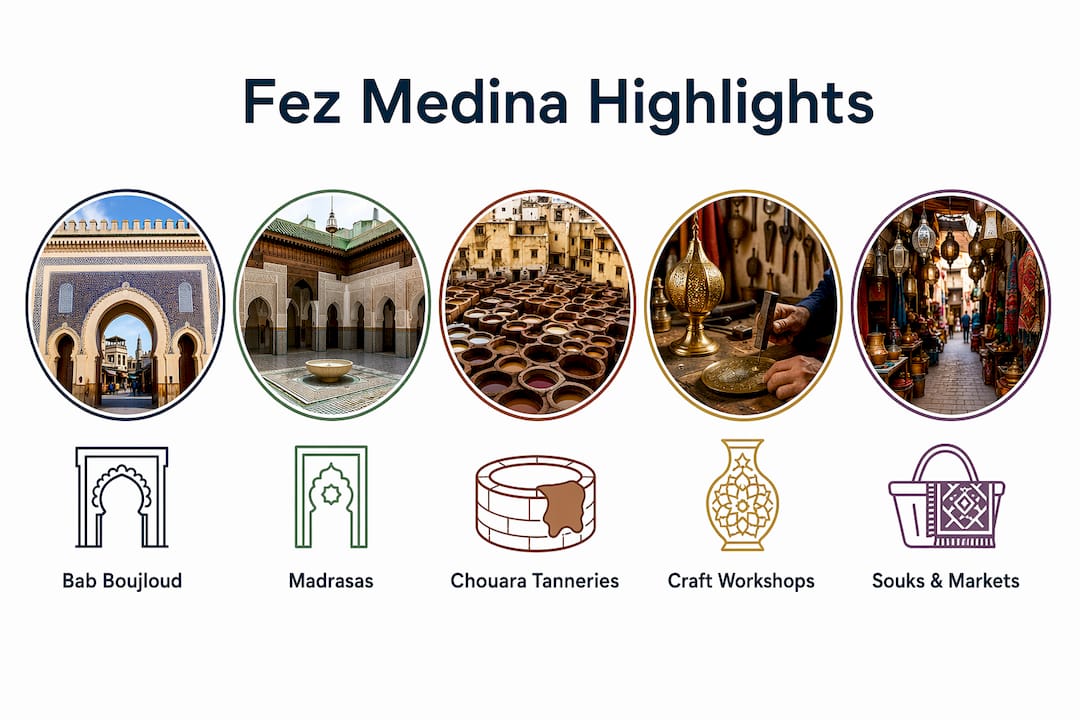
Bab Boujloud, constructed in 1913, is the most photographed entrance to the medina and the most practical orientation point for first-time visitors. The gate’s blue tilework faces the medina; the green side faces outward toward the Ville Nouvelle. Every walking route into the old city passes through or near it, making it the natural anchor for your first morning.
Bou Inania and Al-Attarine Madrasas
These two Merenid-era schools represent the finest surviving examples of medieval Moroccan architecture open to the public. The Bou Inania madrasa allows non-Muslim visitors and features a working minaret, intricately carved cedar wood screens, and tessellated marble floors. Al-Attarine sits beside the perfumers’ souk and draws fewer crowds, making it the better choice for unhurried photography and quiet reflection.
Chouara Tanneries
The Chouara Tanneries are one of three active tanneries in Fez and the most visited. Stone vats filled with natural dyes, including saffron, poppy, and indigo, produce the vivid colors you see on leather goods throughout the souks. Leather workers stand knee-deep in the vats, scraping and dyeing hides by hand. The smell is intense. Shops surrounding the tanneries offer free rooftop viewing platforms, and workers typically hand visitors mint leaves to hold near their faces.
Nejjarine Museum and Al-Qarawiyyin
The Nejjarine Museum occupies a restored 18th-century caravanserai and focuses on traditional Moroccan woodworking. The rooftop terrace alone justifies the entrance fee, offering one of the best elevated views inside the medina. Al-Qarawiyyin, founded in 859 CE and recognized as the world’s oldest continuously operating university, is not open to non-Muslim visitors inside, but its exterior and the surrounding quarter are worth exploring on foot.
- Bab Boujloud: best visited at sunrise for empty lanes and soft light
- Bou Inania: open to non-Muslims; budget 45 minutes minimum
- Al-Attarine: quieter than Bou Inania; located steps from the perfumers’ souk
- Chouara Tanneries: mornings produce the most vivid dye colors
- Nejjarine Museum: rooftop views are the highlight; combine with the nearby woodworking souk
Pro Tip: Arrive at Chouara Tanneries before 10 a.m. The natural light hits the dye vats at the best angle, and the workers are most active. By midday, the viewing platforms fill with tour groups, and the light flattens.
Which immersive cultural and craft experiences should travelers try in Fez?
Sightseeing in Fez covers the surface. The experiences that stay with you are the ones where you participate rather than observe. Cooking classes and food market visits convert eating from passive consumption into a cultural, historical, and sensory exploration unique to Fez’s culinary traditions. That shift from spectator to participant defines the best activities in Fez.
Cooking classes and Fassi cuisine
Fassi cuisine is distinct from the broader Moroccan food tradition. Dishes like pastilla, a savory-sweet pigeon pie wrapped in warqa pastry, and rfissa, a slow-cooked chicken dish over shredded flatbread, reflect centuries of Andalusian and Berber influence. Several riads inside the medina offer half-day cooking classes that begin with a guided market visit to source ingredients. You learn to identify preserved lemons, ras el hanout spice blends, and argan oil before you cook with them. The context makes the meal.
Craft workshops
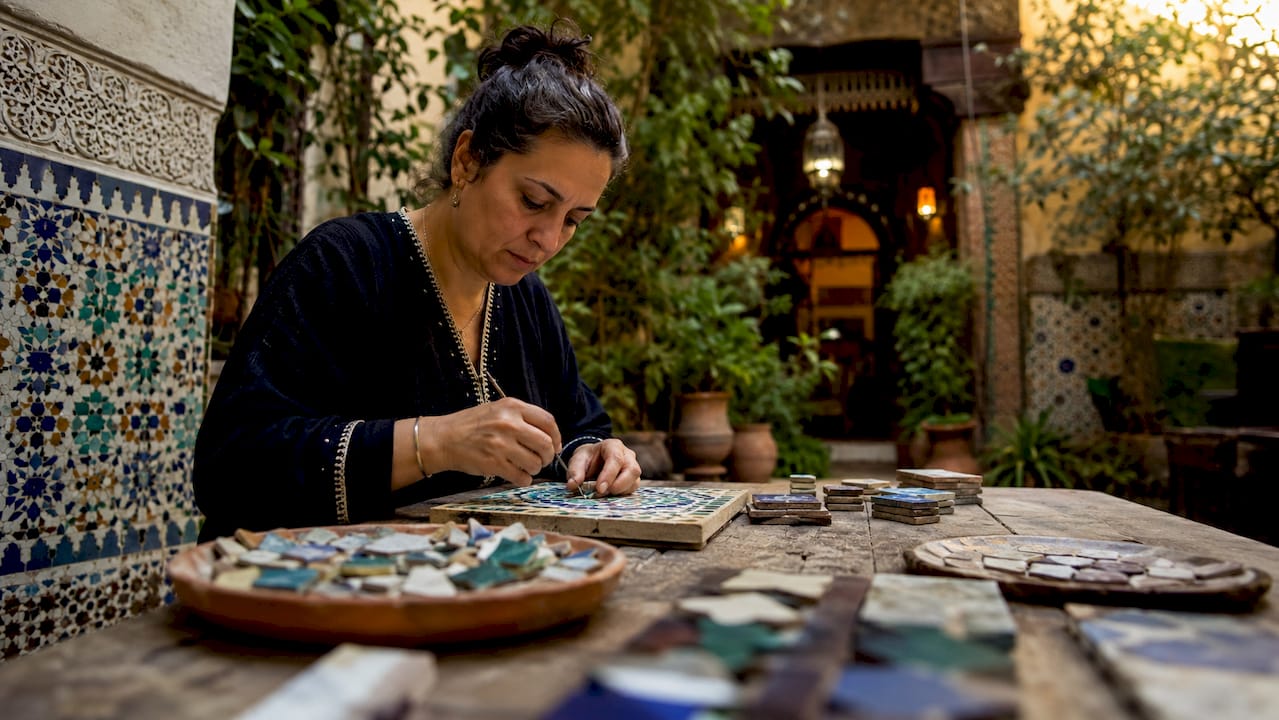
Fez is Morocco’s craft capital, and workshops in rug weaving, zellige tile cutting, and Arabic calligraphy are available through local cooperatives and cultural centers. These are not tourist demonstrations. Zellige cutting, for example, requires geometric precision and takes years to master. A two-hour session gives you a genuine appreciation for the craft and usually results in a small tile piece you take home. Calligraphy workshops, often held in medersas or cultural associations, introduce the logic of Arabic script in a way that changes how you read the city’s inscriptions.
Souk shopping and haggling etiquette
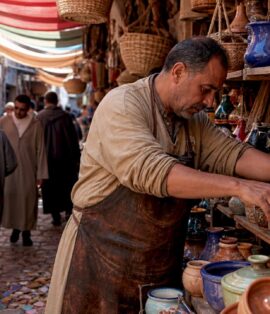
The souks of Fez are organized by trade, a medieval guild system still intact. The leather souk, the spice souk, the brass souk, and the textile souk each occupy distinct streets. Haggling is expected, but the etiquette matters. Open with genuine interest, not aggressive counter-offers. Accepting tea from a shopkeeper creates a social obligation, so only accept if you are seriously considering a purchase. The best pieces, including hand-stitched babouche slippers and hand-painted ceramics, are found in workshops behind the storefronts, not on the street-facing shelves.
Hammam and wellness rituals
Traditional hammams in Fez date to the 14th century and follow a Roman bath layout with graduated heat rooms and decorative domed ceilings. Public hammams cost a fraction of riad spa prices and offer the same core experience. A kessa scrub and black soap treatment takes about 45 minutes and leaves your skin noticeably different. Book a riad hammam if you prefer privacy; use a neighborhood hammam if you want the authentic local version.
- Cooking class with market tour: half-day, book through your riad or a medina cultural center
- Zellige tile workshop: 2 hours, available near the pottery quarter in Fez el-Jedid
- Calligraphy session: 1.5 hours, offered by cultural associations near Al-Qarawiyyin
- Public hammam: budget 30 to 60 dirhams; bring your own flip-flops and a change of clothes
- Souk exploration: allow at least 3 hours; start in the leather souk near Chouara
Pro Tip: For cultural immersion activities that go beyond the standard tourist circuit, ask your riad host to recommend a neighborhood hammam rather than a tourist-facing spa. The experience is more genuine and costs significantly less.
How can visitors best navigate the medina and plan their time effectively?
The medina of Fez contains over 9,000 streets and alleyways. No map fully captures it, and GPS regularly fails inside the dense urban fabric. The car-free medina requires walking as the only mode of transport, which means your feet and your planning are your primary tools. The travelers who enjoy Fez most are the ones who plan loosely around spatial clusters rather than trying to tick off a sequential list.
Here is the approach that works best:
- Divide the medina into two or three clusters. The Bab Boujloud cluster covers the Blue Gate, Bou Inania Madrasa, and the main food souk. The tannery cluster covers Chouara, Al-Attarine Madrasa, and the leather and spice souks. The museum cluster covers Dar Batha and Nejjarine. Assign each cluster a half-day rather than trying to cross the entire medina in one stretch.
- Time your visits strategically. Early morning visits produce quiet lanes, better light for photography, and more vivid tannery colors. Late afternoon, from around 4 p.m. onward, brings the souks back to life after the midday lull and offers the best street food activity. Avoid the tanneries between noon and 2 p.m. when tour groups peak.
- Accept that you will get lost. Getting lost in the medina is not a failure of planning. It is the experience. The rule is to keep moving in a general direction toward a known landmark. Bab Boujloud is always findable by asking locals, and most residents will walk you to the nearest recognizable street.
- Handle the tannery smell with preparation. The tannery odor comes from the natural dyeing process, which uses pigeon droppings as a softening agent. Shops offer mint leaves. Bring your own small bunch of fresh mint if you are sensitive to strong smells. The odor dissipates quickly once you move away from the tannery quarter.
- Use a local guide for your first half-day. A licensed guide from the official Fez guide association costs roughly 200 to 300 dirhams for a three-hour tour and gives you spatial confidence that makes the rest of your independent exploration far more productive. Avoid unofficial guides who approach you near Bab Boujloud. The Fes city navigation guide from TopMoroccoTravel offers additional orientation resources for first-time visitors.
What are the best tranquil spots and dining experiences in Fez?
Active sightseeing in Fez’s medina is intense. The sensory density, the narrow streets, and the constant activity demand deliberate breaks. The city has several genuinely restorative spots that also carry cultural weight, making them worth visiting rather than just resting points.
Dar Batha Museum and Jnan Sbil Gardens
The Dar Batha Museum holds over 6,500 Islamic arts and crafts artifacts in a former late 19th-century palace just beyond Bab Boujloud. Its collection includes ceramics, textiles, and woodwork that provide context for everything you see in the souks. The palace courtyard garden is one of the quietest spaces in the medina area and worth sitting in for 20 minutes. Adjacent to the medina walls, Jnan Sbil Garden is Fez’s oldest surviving royal park, created in the 19th century. It offers shaded paths, fountains, and a complete absence of vendors.
Rooftop cafes and local eateries
Cafe Clock on Derb el-Magana is the most well-known gathering point for travelers and young Fassis. It serves camel burgers, traditional harira soup, and fresh juices and hosts live Gnawa music on select evenings. The rooftop view over the medina is worth the visit alone. For a more local experience, the small restaurants near Rcif Square serve set-menu Fassi lunches, typically including harira, a salad plate, a tagine, and bread, for under 80 dirhams.
Street food worth seeking out
| Food | Where to find it | Best time |
|---|---|---|
| Msemen (layered flatbread) | Street stalls near Bab Boujloud | Morning |
| Harira soup | Rcif Square restaurants | Lunch and evening |
| Sfenj (Moroccan doughnuts) | Near the main souk entrances | Morning |
| Mechoui (slow-roasted lamb) | Rcif and Seffarine Square area | Midday |
| Fresh-squeezed orange juice | Throughout the medina | Any time |
Evening social life in Fez centers on tea rather than alcohol. Most Medina cafes are alcohol-free and stay open late, with mint tea, chess, and conversation as the primary activities. The Fondouk Bazaar area near the tanneries has several rooftop tea spots that offer views without the daytime crowds.
Key takeaways
Fez rewards travelers who prioritize depth over coverage, with the medina’s living landmarks, craft workshops, and culinary traditions delivering the most memorable experiences when approached at a deliberate pace.
| Point | Details |
|---|---|
| Start at Bab Boujloud | Use the 1913 Blue Gate as your daily orientation anchor and first morning photo stop. |
| Visit tanneries in the morning | The Chouara Tanneries show the most vivid dye colors before 10 a.m. when natural light is strongest. |
| Plan by spatial cluster | Divide the medina into two or three zones per day to avoid backtracking in the 9,000-street network. |
| Participate, not just observe | Cooking classes, hammam visits, and craft workshops deliver cultural depth that sightseeing alone cannot. |
| Use Dar Batha and Jnan Sbil for recovery | These two spots provide genuine rest and cultural context between active medina sessions. |
Why slowing down in Fez changed how I travel everywhere else
Most travelers arrive in Fez with a list: tanneries, madrasas, Blue Gate, done. I understand the impulse. The medina looks manageable on a map. It is not. The first time I tried to cover the whole thing in a day, I ended up exhausted, slightly lost, and with photographs that looked like every other travel blog. The second visit, I chose two neighborhoods and stayed in them.
The difference was not just logistical. When you stop trying to see everything, you start noticing things. The sound of a weaver’s loom coming from a doorway you would have walked past. The smell of fresh cedar shavings outside a carpenter’s workshop near Seffarine Square. A calligrapher writing wedding invitations by hand in a courtyard that has no sign and no tourist infrastructure whatsoever.
Fez is one of the few cities where the authentic medina experience is not a performance staged for visitors. The artisans are working. The students are studying. The hammams are full of neighborhood residents. You are a guest in a functioning city, not a theme park. That distinction requires a different posture from the traveler.
My practical advice: resist the urge to hire a guide who promises to show you everything. Choose someone who knows two or three neighborhoods deeply. Spend your mornings at the tanneries and madrasas, your afternoons in a single souk, and your evenings at a rooftop cafe with mint tea. On your last day, wander without a plan. The medina will show you something you did not know to look for.
Fez also has a modern side that most guides ignore. The Ville Nouvelle, built during the French Protectorate period, has excellent patisseries, bookshops, and a completely different pace. Spending one evening there gives you a useful contrast that makes the medina feel even more extraordinary by comparison.
— Topmoroccotravel.com
Plan your Fez visit with TopMoroccoTravel
Topmoroccotravel designs Fez itineraries around the experiences described in this guide, not generic city tours. The luxury cultural tour packages for Fez include private access to working craft cooperatives, guided tannery visits timed for optimal morning light, and curated culinary experiences with local Fassi families. Every itinerary is built around the medina’s spatial logic, so you cover the right things in the right order without backtracking or wasted time. For travelers who want the depth of Fez without the disorientation, Topmoroccotravel’s guided Fez tours offer fully customizable programs for individuals, couples, and small groups. Contact the team directly to build a Fez itinerary around your specific interests and travel dates.
FAQ
What is the best time of day to visit the Chouara Tanneries?
Morning visits before 10 a.m. produce the most vivid dye colors and the most active working conditions. Tannery shops provide free rooftop viewing platforms and typically offer mint leaves to manage the strong odor from the natural dyeing process.
Is the Fez medina safe to explore independently?
The medina is generally safe for independent exploration. The main challenge is navigation, not safety. Using a licensed guide for your first half-day builds spatial confidence, and the official guide association near Bab Boujloud is the reliable source for vetted guides.
How many days do you need in Fez?
Three full days is the minimum for a meaningful visit. Day one covers the Bab Boujloud cluster and madrasas. Day two covers the tanneries, souks, and Nejjarine Museum. Day three allows for a cooking class, a hammam visit, and relaxed wandering in Jnan Sbil Garden and Dar Batha Museum.
Can non-Muslims enter the historic madrasas in Fez?
Bou Inania Madrasa is open to non-Muslim visitors and charges a small entrance fee. Al-Attarine Madrasa is also accessible. Al-Qarawiyyin University and mosque are not open to non-Muslims, but the surrounding quarter is fully accessible on foot.
What should I know about shopping in Fez’s souks?
The souks are organized by trade guild, so leather, spices, brass, and textiles each occupy distinct streets. Haggling is standard practice. Accepting tea from a shopkeeper carries a social expectation of serious interest, so only accept if you intend to consider a purchase seriously.


Comments are closed