




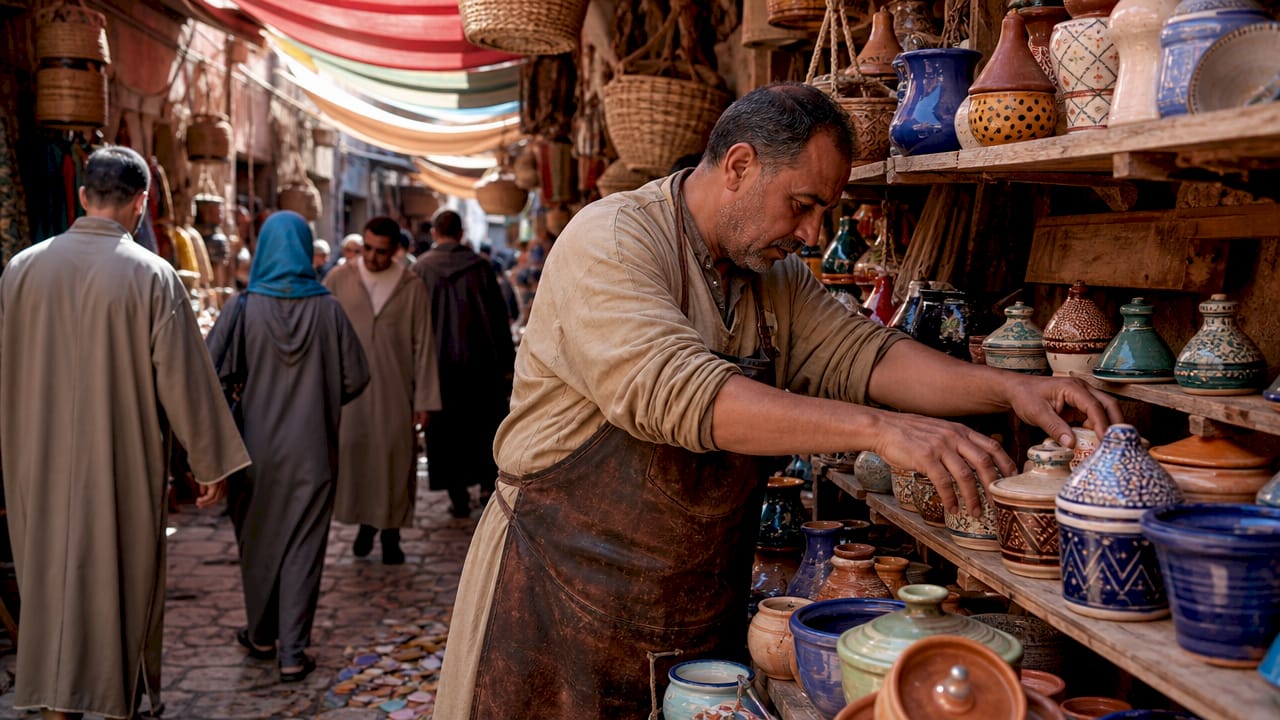
- Moroccan artisanat, a legally recognized sector, preserves traditional crafts like zellige, leatherwork, and rugs across regions with distinct cultural influences.
- Souks function as authentic economic and social hubs where buyers engage directly with skilled artisans, ensuring genuine craftsmanship and fair livelihoods.
- Experiencing workshops firsthand provides deeper cultural insight, as these spaces embody Morocco’s rich craft transmission rooted in centuries-old apprenticeships.
Morocco’s souks and artisan culture are defined by artisanat, a legally structured sector under Loi 50-17 that classifies handmade and semi-handmade goods carrying cultural, aesthetic, or functional value. These markets are not tourist constructs. They are living institutions where zellige tilework, hand-tanned leather, and hand-knotted rugs are produced, sold, and passed down through generations. Understanding this distinction changes everything about how you experience Morocco.
What makes Morocco souks and artisan culture unique?
Moroccan artisanat is a legally defined sector with three categories: pure artisanat d’art (fine decorative work), artisanat de service (functional crafts), and artisanat utilitaire (everyday utility goods). Each category reflects a different relationship between maker, material, and community. This legal framework is not a bureaucratic formality. It signals that Morocco treats its craft sector as a national asset, not a cottage industry.
The cultural threads running through Moroccan handicrafts are layered and specific. Amazigh geometric patterns appear in Berber rugs from the Atlas Mountains. Arab calligraphic motifs define carved plasterwork in Fez medinas. Andalusian influences shape the intricate woodwork of Marrakech riads. Jewish artisan communities, historically concentrated in Fez and Essaouira, contributed silversmithing and brass-engraving traditions that survive today. No single craft belongs to one culture. Every piece is a negotiation between these influences.
Regional variation is equally sharp. Fez produces the finest zellige and hand-painted ceramics because of its clay deposits and centuries-old kiln traditions. Marrakech specializes in leather goods and babouche slippers, fed by the tanneries of the Medina. Essaouira is the center of thuya wood marquetry, a craft unique to the region’s cedar forests. When you buy a craft in Morocco, geography is part of its story.
Authenticity indicators matter more than most guides admit. Real zellige tiles carry visible chisel marks on the reverse. Genuine leather goods have a distinct smell that mass-produced synthetic alternatives cannot replicate. Workshop context is the strongest signal of all. A piece made in front of you by an artisan who can explain every step of its production is authentic by definition.
Pro Tip: Ask the artisan which raw materials they use and where those materials come from. A genuine craftsperson in Fez will tell you exactly which tannery supplied the leather or which quarry produced the clay. Vague answers are a reliable sign of mass-produced goods dressed up for tourist sale.
How do souks function as economic and social hubs?
Moroccan souks operate on a logic that predates modern retail by centuries. They are not organized by brand or category in the Western sense. They are organized by craft guild and trade, which means the spice souk, the leather souk, and the metalwork souk each occupy distinct physical zones within the medina. This structure is deliberate. It creates price transparency and quality competition among vendors selling identical goods.
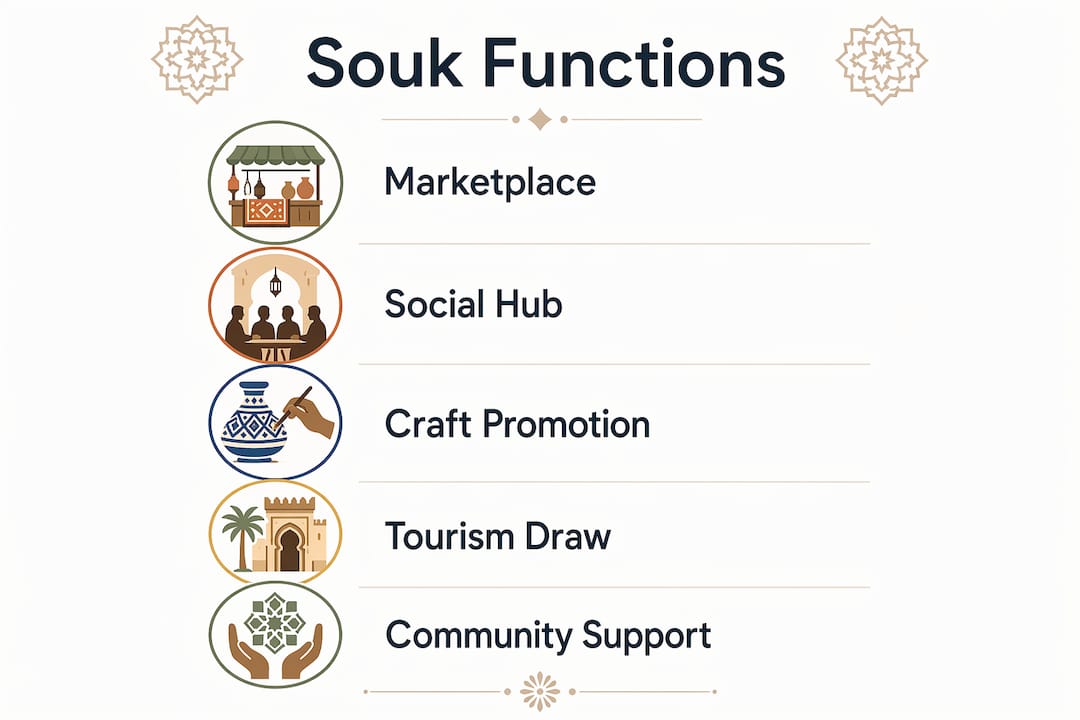
Souks remain integral to daily Moroccan life as places for weekly shopping and social interaction, not just tourist browsing. Locals buy spices, household goods, and fresh produce in the same alleys where visitors shop for souvenirs. This overlap is what keeps souk culture alive. When a market serves only tourists, quality drops and prices inflate. When locals shop there too, standards hold.
The economic scale of this sector is significant. Morocco’s handicraft sector employs about 20% of active workers, with women representing 54% of artisans. Handicraft exports reached $130 million in 2025. That figure represents real livelihoods, not decorative tradition. Every purchase in a souk or cooperative connects directly to a family’s income.
The social architecture of souks is equally important to understand:
- Vendor networks operate on long-term trust. Stall owners refer customers to neighboring specialists, share storage, and cover each other during prayer times.
- Haggling is a social ritual, not a confrontation. Lonely Planet describes it as a centuries-old, enjoyable trading practice that strengthens community bonds between vendors and buyers.
- Craft turnover maintains quality. Artisans who sell directly from their workshops have reputational skin in the game. Poor work damages their standing in a tight-knit guild community.
- Cooperatives offer fixed prices and verified authenticity, serving buyers who prefer transparency over negotiation.
“The souk is not a place you visit. It is a place you enter, and it enters you back.” This is how one Marrakech leather artisan described his medina to a Topmoroccotravel guide, and it captures the reciprocal nature of the exchange better than any travel brochure.
Where can you experience artisan craftsmanship firsthand?
The medina functions as an open-air factory. Street-level ateliers line the alleys of Fez, Marrakech, Meknes, and Essaouira, where artisans work in fondouks and visitors can watch, ask questions, and sometimes try crafts themselves. This is not a performance staged for tourists. These are working production spaces that happen to be accessible.
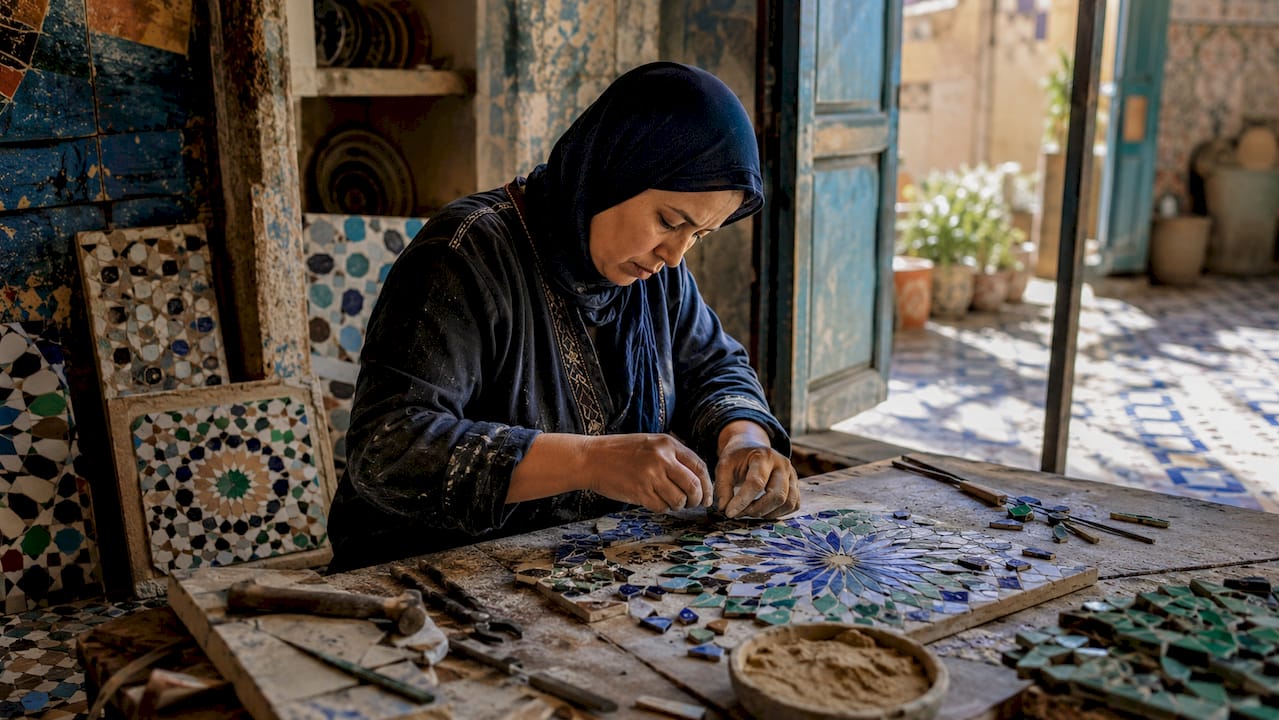
Specific neighborhoods reward focused exploration. Ain Nokbi in Fez is the leather district, where the famous Chouara Tannery sits at its center. The surrounding streets are lined with leather workshops producing bags, belts, and babouches at every stage of production. Zellige workshops cluster near the potters’ quarter of Fez, where you can watch craftsmen chip geometric tiles from fired clay slabs with a small hammer and chisel. Metalwork ateliers in Marrakech’s Medina produce copper lanterns and brass trays in workshops barely wider than a doorway.
The table below compares the two main ways travelers access authentic Moroccan crafts:
| Access Point | Price Transparency | Authenticity Assurance | Cultural Interaction |
|---|---|---|---|
| Souk stall | Negotiated via haggling | Variable; requires buyer knowledge | High, direct vendor contact |
| Artisan cooperative | Fixed, government-regulated | High, certified production standards | Moderate, less spontaneous |
| Workshop atelier | Often negotiable | Highest, production visible | Highest, process fully observable |
Cooperatives like those supported by the Entraide Nationale program offer fixed prices and certified goods, which suits travelers who want assurance without negotiation. Souk stalls offer lower prices if you know what you are looking at and are willing to engage. Workshop ateliers offer the richest experience because you see the craft being made.
Photography etiquette is non-negotiable. Always ask permission before photographing artisans, and be prepared to tip Dh5 to Dh10. Skipping this step damages rapport and can close off access to workshops that would otherwise welcome curious visitors. Artisans who feel respected are far more likely to explain their process, show you tools, and let you handle unfinished work.
Pro Tip: Use the best products to buy as a pre-trip reference to identify which crafts are worth prioritizing in each city. Knowing what you want before you enter a souk prevents the decision fatigue that leads to impulse purchases of mass-produced goods.
Why is zellige tilework culturally protected and nationally significant?
Zellige tilework is not decoration. It is a sophisticated visual language deeply tied to Moroccan identity, encoding mathematical precision, spiritual geometry, and regional aesthetic traditions into every panel. A single zellige installation in a mosque or riad can contain hundreds of individually hand-cut tiles, each shaped by a master craftsman (maallem) using techniques unchanged for over a thousand years.
Morocco is actively working with UNESCO to safeguard zellige as intangible cultural heritage. The effort involves formal documentation of production methods, advocacy for international recognition, and legal protections against industrial imitation. This is not ceremonial. Morocco filed formal complaints after neighboring countries began mass-producing machine-cut imitations marketed as zellige, threatening both the craft’s economic value and its cultural integrity.
The transmission system that keeps zellige alive is the master-apprentice lineage. Maalems undergo 8 to 12 years of apprenticeship before they are considered qualified to produce work independently. That timeline is not inefficient. It is the minimum required to internalize the geometric vocabulary, material knowledge, and physical precision the craft demands. No app or tutorial replaces it.
The table below shows key crafts, their primary production cities, and their current heritage status:
| Craft | Primary City | Heritage Status |
|---|---|---|
| Zellige tilework | Fez | UNESCO safeguarding in progress |
| Tanned leather goods | Fez, Marrakech | Recognized national artisanat |
| Thuya wood marquetry | Essaouira | Protected regional craft |
| Hand-knotted Berber rugs | Atlas Mountains | Recognized Amazigh heritage |
| Carved plasterwork (gebs) | Fez, Meknes | National architectural heritage |
For travelers, this cultural weight enriches every encounter. When you watch a maallem cut zellige in a Fez workshop, you are watching a skill that took a decade to acquire and carries a civilization’s aesthetic logic. That context transforms a souvenir into a piece of living history. The cultural immersion activities available through guided tours are specifically designed to put visitors in these moments rather than outside them.
Key takeaways
Morocco’s souks and artisan culture form a legally structured, economically vital, and culturally irreplaceable system that rewards travelers who engage with it on its own terms.
| Point | Details |
|---|---|
| Artisanat is legally defined | Loi 50-17 establishes three craft categories, giving authenticity a formal framework buyers can reference. |
| Souks serve locals first | Markets that serve daily Moroccan life maintain higher quality and lower prices than purely tourist-facing venues. |
| Economic scale is real | The sector employs 20% of active workers and generated $130 million in exports in 2025. |
| Zellige is nationally protected | Morocco is pursuing UNESCO recognition to defend zellige from industrial imitation and preserve craft transmission. |
| Workshop visits outperform souk browsing | Seeing production firsthand is the most reliable way to verify authenticity and understand cultural value. |
What I’ve learned from years inside Moroccan souks
Most travel advice about Moroccan souks focuses on haggling tactics and scam avoidance. That framing misses the point entirely. The souks of Marrakech, Fez, and Essaouira are not obstacle courses. They are communities, and the artisans working inside them are professionals who have spent years mastering their craft.
My honest observation, after guiding travelers through medinas across Morocco, is that the visitors who get the most out of these spaces are the ones who slow down and ask questions. Not “how much?” but “how long did this take?” or “where does this dye come from?” Those questions shift the dynamic from transaction to conversation, and conversations in Moroccan souks tend to go somewhere interesting.
The haggling anxiety that many first-time visitors carry is understandable but largely misplaced. Haggling is a social practice that vendors genuinely enjoy. A vendor who quotes you a high opening price is not trying to cheat you. They are starting a conversation. Counter with respect and humor, and you will almost always land at a fair price while leaving both parties satisfied.
What I find most underappreciated is the apprenticeship culture. When you buy a piece of zellige or a hand-stitched leather bag, you are not just buying an object. You are buying the output of a system that took a decade to produce the person who made it. That is worth paying for. Travelers who understand this spend more thoughtfully and leave with pieces that mean something.
The Morocco greetings and hospitality customs that govern souk interactions are not formalities. They are the operating system of the market. Learn a few words of Darija, accept the mint tea when it is offered, and treat the souk as a place you are a guest in rather than a consumer passing through.
— Topmoroccotravel.com
Explore Morocco’s artisan culture with expert guidance
TopMoroccoTravel designs tours that put you inside the craft process, not just in front of finished goods. Our Morocco tours include guided visits to working zellige workshops in Fez, leather tannery districts in Marrakech, and thuya wood ateliers in Essaouira, with local guides who have established relationships with maalems and cooperative leaders. These connections open doors that independent travelers rarely find. Every itinerary is built to support fair artisan wages and give you the cultural context that transforms a market visit into a genuine encounter. Browse our cultural immersion packages to find the experience that fits your travel style.
FAQ
What is “artisanat” in Morocco?
Artisanat is Morocco’s legally defined craft sector, established under Loi 50-17, covering handmade and semi-handmade goods with cultural, aesthetic, or functional value across three formal categories.
What are the best souks to visit in Marrakech?
The souks of Marrakech are best explored by district: the leather souk near Bab Debbagh, the spice souk in Rahba Kedima, and the metalwork souk off Jemaa el-Fna each offer distinct craft concentrations.
How do I know if a Moroccan craft is authentic?
Look for production markers like chisel marks on zellige tile backs or genuine leather smell, and prioritize purchases made directly from workshop ateliers where you can observe the production process.
Is haggling expected in Moroccan souks?
Haggling is a standard and socially valued practice in Moroccan souks. Fixed prices apply only in government-certified cooperatives. Elsewhere, an opening offer is the start of a negotiation, not a final price.
What should I buy in Moroccan souks?
The strongest purchases are city-specific crafts: zellige tiles and hand-painted ceramics in Fez, leather babouches and bags in Marrakech, and thuya wood boxes in Essaouira. Buying where a craft is produced guarantees the best quality and price.
Comments are closed