




TL;DR:
- A well-planned Morocco trip depends more on pacing than duration, with focused regional travel offering richer experiences than rushing across many destinations.
- Seven days can provide a deep, fulfilling experience when centered on one or two regions, while ten days comfortably cover three hubs without fatigue.
- Fourteen days enable immersive exploration of deserts, villages, and coastal areas, creating meaningful connections with local culture.
Planning a trip to Morocco and staring at a blank calendar, wondering how many days you actually need? You’re not alone. Whether you’re planning 7-day, 10-day, or 2 week itineraries, the most common mistake travelers make is assuming more days automatically means a better trip. Morocco rewards focus. A rushed 14-day sprint across six cities will leave you exhausted, while a thoughtful one-week travel plan built around two regions can feel genuinely transformative. This guide breaks down exactly what each trip length gives you, what it costs you in pace and depth, and how to build a Morocco itinerary that matches how you actually want to travel.
Table of Contents
- Key takeaways
- 7 day, 10 day, or 2 week itineraries: choosing the right length
- How to make the most of a 7-day Morocco trip
- Planning a 10-day travel itinerary in Morocco
- Two week vacation ideas: the case for a 14-day Morocco trip
- Logistics that make or break any Morocco itinerary
- Matching your itinerary to your travel style
- My honest take on trip length in Morocco
- Plan your Morocco trip with Topmoroccotravel
- FAQ
Key takeaways
| Point | Details |
|---|---|
| Trip length isn’t everything | Focused regional travel consistently outperforms packed multi-stop itineraries regardless of duration. |
| 7 days works for single-region depth | One week is enough for a rich Marrakech, Fez, or coastal experience when you resist the urge to see it all. |
| 10 days is the sweet spot | A 10-day travel itinerary covering three hubs gives you highlights without the fatigue that longer trips can cause. |
| 14 days unlocks real immersion | Two weeks allows desert camping, village stays, and off-the-beaten-path experiences that shorter trips simply can’t accommodate. |
| Logistics make or break pacing | Buffer your transit times, limit hotel changes, and book cultural sites well in advance to protect your itinerary. |
7-day, 10-day, or 2 week itineraries: choosing the right length
The single biggest mistake in Morocco trip planning isn’t choosing the wrong city. It’s choosing the wrong pacing model. Research consistently shows that 7 days suits single-region travel, 10 days covers major highlights comfortably, and 14 days opens the door to genuinely immersive, multi-regional experiences. Knowing which category your trip falls into changes everything about how you structure your days.
Morocco is not a small country with a handful of must-sees. You have imperial cities like Fez, Marrakech, Meknes, and Rabat. You have the Sahara Desert. You have the Atlas Mountains, the Atlantic coast, the Rif Mountains, and the coastal gem of Essaouira. Trying to hit all of these in any duration is a recipe for spending half your trip in a car or on a train. The travelers who leave Morocco genuinely moved are almost always the ones who went deep rather than wide.
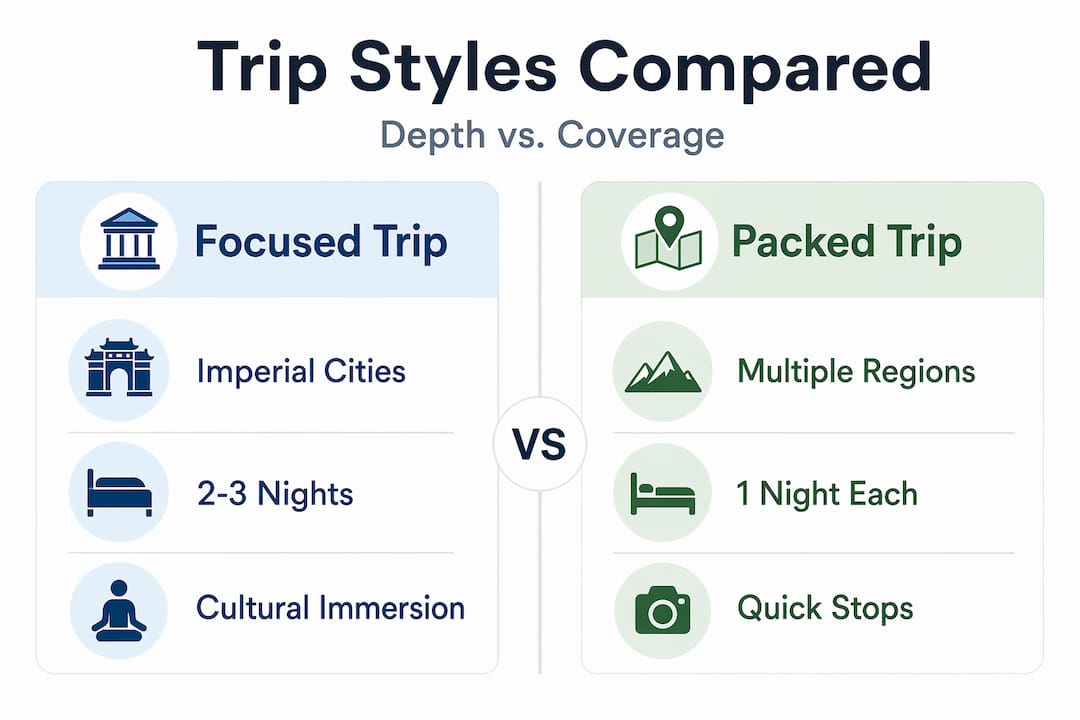
Before you even open a map, ask yourself one question: do you want to feel like a traveler or a tourist? Tourists check off landmarks. Travelers absorb neighborhoods, share meals with locals, and find themselves wandering souks without an agenda. Your answer to that question should determine your itinerary structure far more than how many days you have available.
How to make the most of a 7-day Morocco trip
Seven days sounds limiting. In Morocco, it’s actually enough for a deeply rewarding trip, provided you treat it as a focused regional experience rather than a sampler platter.
Best routes for one-week travel plans
The strongest one-week Morocco itinerary typically centers on one primary city plus one or two day-trip destinations. Consider these three focused options:
- The Marrakech and High Atlas route: Spend four nights in Marrakech exploring the medina, Djemaa el-Fna, the souks, and Bahia Palace. Use the remaining days for an Atlas Mountain excursion and a sunset drive through the Ourika Valley.
- The Fez deep dive: Fez is arguably Morocco’s most complex city. Five nights here with a day trip to Meknes and the Roman ruins of Volubilis is a legitimate week-long itinerary that will still feel rushed in places.
- The Atlantic coast escape: Casablanca arrival, two nights in Rabat, then three nights in Essaouira. This route is perfect for travelers who want culture without the intense sensory overload of the imperial city medinas.
Pro Tip: Book your riad well in advance for the medina neighborhoods in Fez and Marrakech. Navigation apps don’t work inside the old city walls, and a good riad host is worth more than any guidebook for your first 48 hours.
Pacing and accommodation for 7-day trips
Staying 2 to 3 nights per location gives you the rhythm you need to stop feeling like a visitor and start feeling oriented. On a 7-day trip, this means committing to one or two locations and refusing to let travel envy push you somewhere else. That said, quality accommodation compounds this effect significantly. TopMoroccoTravel’s luxury 7-day itinerary guide maps out exactly how to pair the best riads and boutique hotels with the experiences that matter most in each region.
Planning a 10 day travel itinerary in Morocco
Ten days is where Morocco starts to reveal itself. You have enough time to cover three meaningful hubs, experience the contrast between city and desert or city and coast, and still have afternoons that aren’t scheduled down to the minute.
A sample 10-day Morocco itinerary structure
A well-structured 10 day travel itinerary for Morocco typically follows this progression:
- Days 1 to 3: Marrakech. Arrive, recover from jet lag on day one, and spend days two and three in the medina, the Majorelle Garden, and the souks. One evening at Djemaa el-Fna is non-negotiable.
- Days 4 to 6: Desert circuit. Drive or tour south through the Draa Valley, spend a night in an Erg Chebbi desert camp near Merzouga, and return through the Dades Gorge on day six.
- Days 7 to 8: Fez. Take the night train or a guided transfer north to Fez. Two full days here is the minimum for the medina, the tanneries, and the Bou Inania Madrasa.
- Days 9 to 10: Chefchaouen or coastal return. Depending on your energy level, either spend a final night in the blue-painted streets of Chefchaouen before flying from Fez, or return to Casablanca via Rabat.
| Hub | Recommended nights | Key experiences |
|---|---|---|
| Marrakech | 3 | Souks, Djemaa el-Fna, Atlas day trip |
| Desert (Merzouga/Dades) | 2 | Camel trekking, desert camping, gorge drive |
| Fez | 2 | Medina, tanneries, Volubilis day trip |
| Chefchaouen or coast | 1 to 2 | Blue city, Rif Mountains, Atlantic towns |
Using three well-chosen hubs keeps transit below 30% of your total trip time. That’s the difference between a trip where you’re always moving and one where you actually remember what you saw.
Pro Tip: The Marrakech to Merzouga road takes roughly six hours by car. Add your 40% buffer and plan for seven to eight hours, especially if you stop at Ait Benhaddou, which you absolutely should. Book your desert camp in advance for peak seasons (March to May and October to November).
For specific day-by-day breakdowns and transport logistics, Topmoroccotravel’s Morocco 10-day itinerary from Marrakech is the most detailed resource available for this route.
Transportation logic for 10-day trips
Trains connect Casablanca, Rabat, Meknes, Fez, and Tangier efficiently, with typical travel times between hubs running 90 to 180 minutes. For everything south of Marrakech, you’ll need either a rental car or a guided tour. One smart approach: take trains between the northern cities and use a guided tour operator for the desert circuit. This gives you the efficiency of rail where it exists and the flexibility of a driver where the roads get complex.
For popular cultural sites, advance booking is critical. Morocco’s equivalent of the sold-out Alhambra scenario happens regularly at major medina experiences and festival-period accommodations. Book your riad and desert camp at least six to eight weeks out during high season.
Two week vacation ideas: the case for a 14-day Morocco trip
Two weeks changes the nature of your Morocco experience entirely. You’re no longer selecting from a highlights menu. You’re building a relationship with a country.
What 14 days actually unlocks
With the best itineraries for 2 weeks, the biggest shift is that you gain the ability to slow down without feeling like you’re missing something. Here’s what genuinely becomes possible:
- Desert camping with intent. Instead of one rushed night in Merzouga, you have the option to do a two-night desert circuit, wake up for the sunrise dune hike, and depart on your own timeline.
- Rural village visits. The road between Marrakech and the Draa Valley passes through Amazigh Berber villages where a 14-day schedule lets you stop, share tea, and actually talk to people.
- Coastal immersion. Essaouira deserves two full nights. The medina, the ramparts, the seafood, and the wind that makes the whole city feel alive are things a 10-day traveler often has to skip.
- Chefchaouen without rushing. Most 10-day travelers spend one night in Chefchaouen. With two weeks, you can take morning hikes up to the Spanish mosque, explore the old quarter at the unhurried pace it deserves, and watch the light change on those blue walls.
- Fes festival timing. If your travel window includes June, a 14-day itinerary lets you plan around the Fes Festival of World Sacred Music, one of the most remarkable cultural events in North Africa.
Focusing on fewer regions deeply produces better trips than covering many regions quickly. Two travelers in 10 days who go deep on two regions will leave more satisfied than two travelers in 14 days racing through five. The extra days in a two week vacation don’t just add destinations. They add the breathing room that makes any destination feel real.
Structuring a 14-day itinerary to avoid fatigue
The risk with two weeks is overloading. Attempting to see everything leads to exhaustion and diminishing returns. A strong 14-day Morocco structure looks like this: three nights in Marrakech, two nights for the desert circuit, two nights in Fez, one night in Meknes, one night in Chefchaouen, two nights in Essaouira, and a final night back in Marrakech or Casablanca before your flight. That’s ten separate experiences without feeling frantic because most legs involve only one transit day per cluster.

For the cultural deep dives that make 14-day trips memorable, Topmoroccotravel’s guide to cultural immersion in Morocco maps out the experiences that go beyond the standard tourist circuit.
| Trip length | Best for | Coverage |
|---|---|---|
| 7 days | Single-city depth, first-time visitors to one region | 1 to 2 cities |
| 10 days | First-time Morocco visitors wanting highlights | 3 cities plus desert |
| 14 days | Return visitors or experience-first travelers | 4+ cities plus desert plus coast |
Logistics that make or break any Morocco itinerary
Short trip planning tips only matter if the logistics behind them are sound. Here are the practical factors that separate a smooth Morocco trip from a stressful one.
- Budget 40% extra transit time over what any navigation app tells you. Real road conditions in Morocco, especially on mountain passes and rural routes, require this buffer consistently.
- Use the hub-and-spoke model. Pick your city base and do day trips rather than moving accommodations every night. Reducing frequent hotel changes measurably improves travel satisfaction and depth of experience.
- Rent a car only outside cities. City parking in Marrakech and Fez is expensive and unnecessary. Pick up your rental on the day you leave for the desert or mountains, and return it when you come back.
- Book guided tours for the desert circuit. As Topmoroccotravel’s resource on why guided tours work best explains, the roads south of Marrakech are navigable but genuinely benefit from local knowledge, especially when desert tracks are involved.
- Pre-book the non-negotiables. Desert camps, popular riads, and festival-period accommodations sell out weeks in advance. Leave spontaneity for meals and market wandering, not your bed for the night.
Pro Tip: If you’re considering a mixed self-drive and guided tour approach, structure it so your guided segment covers the desert circuit and your self-drive segment covers the Atlantic coast. The coast road between Agadir and Essaouira is one of the most beautiful drives in Morocco and easy to navigate independently.
Matching your itinerary to your travel style
Morocco serves three very different traveler profiles, and knowing which one describes you helps you prioritize what goes in and what stays out.
For adventure travelers, the non-negotiables are the Sahara Desert excursion near Merzouga or Zagora, trekking in the High Atlas (Toubkal is North Africa’s highest peak at 4,167 meters), and the gorge drives of the Dades and Todra. A 10-day itinerary can hit all three; 14 days lets you go deeper on each.
For culture-focused travelers, the imperial cities of Fez, Meknes, and Marrakech are the core. Add the UNESCO-listed ksar of Ait Benhaddou and the Jewish heritage quarter of Fez’s mellah, and you have a culturally dense itinerary that rewards longer stays. The exploration tips for Moroccan cities on TopMoroccoTravel are particularly useful for navigating the medinas efficiently.
For relaxation-focused travelers, Morocco’s riads and luxury hotels offer spa experiences that rival anywhere in the Mediterranean. Essaouira is the obvious coastal choice, but Agadir suits travelers who want beach time alongside cultural access. TopMoroccoTravel’s Morocco luxury hotels guide covers the best properties across all these destinations.
The right itinerary isn’t the longest or shortest one. It’s the one that puts your priorities in the best possible order.
My honest take on trip length in Morocco
I’ve spent years helping travelers plan Morocco trips, and the pattern I see most often is clear: the travelers who struggle most are the ones who optimized for coverage. They went to eight cities in 10 days and came home with beautiful photos and a vague sense of dissatisfaction they can’t quite explain.
My honest view is that 10 days is the optimal duration for a first visit to Morocco. Not because you’ll see everything, but because you’ll see enough of the right things without the fatigue that flattens your appreciation by day 12. Three hubs, two or three nights each, one desert night, one mountain experience. Done.
I also think the seven-day Morocco trip is massively underrated. I’ve seen people plan a single week around Fez and return home more genuinely affected by Morocco than people who did twice the time in twice the cities. Depth wins. It almost always wins.
What I’d caution against is treating your itinerary like a bucket list. The moment you’re rushing through a 12th-century medina to make a train, you’ve lost the plot. Morocco asks you to slow down. The country’s whole culture, from the tea ceremony to the souk negotiation, is built around the idea that time spent with something matters. The best itinerary you can build is one that respects that.
— Top Morocco Travel
Plan your Morocco trip with TopMoroccoTravel.
TopMoroccoTravel builds custom itineraries for travelers at every duration, from focused one week travel plans to full two week vacation ideas. Whether you want a luxury city tour through Marrakech and Fez, a guided Sahara desert adventure, or a fully tailored 14-day multi-region experience, the team handles every detail, including transportation, accommodation, cultural site bookings, and 24/7 support. Browse the complete range of Morocco tour itineraries to find a structure that matches your travel style. Every trip is built around what you actually want from Morocco, not a generic template.
FAQ
How many days do you really need for Morocco?
Ten days covers Morocco’s major highlights comfortably for most first-time visitors. Seven days works well for a single-region focus, while 14 days allows multi-region exploration, including the desert, coast, and imperial cities.
What is the best structure for a 10-day Morocco itinerary?
The strongest 10 day travel itinerary uses three hubs with two to three nights each, keeping transit under 30% of total trip time. A typical structure is Marrakech, the desert circuit, and Fez, with an optional night in Chefchaouen.
Is 7 days enough to see Morocco?
Yes, if you focus on one region rather than trying to cover the whole country. Seven days in Marrakech with Atlas day trips, or a full week in Fez, delivers a genuinely rich experience without the burnout of over-traveling.
What should you book in advance for a Morocco trip?
Book desert camps, popular riads in Fez and Marrakech, and any guided tours at least six to eight weeks before your trip during peak season. Last-minute availability at top properties is rare in spring and fall.
Is a guided tour or self-drive better for Morocco?
It depends on where you’re going. Guided tours work best for the desert circuit south of Marrakech, where local knowledge matters most. Self-drive suits the Atlantic coast and the northern mountain routes where roads are straightforward and the freedom adds real value.





Comments are closed